Children forced to give up school for work as fighting upends daily life in Yemen
In the mornings, 13-year-old Muneer Farie went to school, and in the afternoons he helped his father feed the livestock. He took his studies seriously, dreaming of becoming the first teacher in his family of farmers.
As fighting approached his village in al-Wazeyah district in Taiz, Yemen, two weeks ago, Muneer’s focus started to drift from his lessons. The classroom echoed with the distant sounds of explosions and gunfire. His home was suddenly on the frontline of renewed fighting between the Iran-aligned Houthis and the Saudi-backed Yemeni government.
“We heard there was fighting in surrounding areas but we didn’t expect it would reach our village that fast,” Muneer said. “As soon as the sounds of clashes approached our village, we took our livestock and important belongings and fled home early in the morning.”
He and his family fled south-west, moving to a camp set up for displaced people in al-Shimayateen, Taiz. They arrived penniless and lacking even the most basic supplies.
Muneer and his family are some of the more than 130,000 people displaced by recent fighting in Yemen, which started in September when the Houthis launched a renewed military campaign and rapidly moved south-west, seizing control of towns along the Red Sea coast.
The Houthis’ campaign interrupted years of relative calm that had prevailed over Yemen, with frontlines remaining broadly static since a UN-mediated ceasefire came into force in 2022.
The Houthis are now battling government forces and a Saudi air campaign to seize strategic highlands and supply lines on the outskirts of Taiz. Civilians have been driven out of their homes by the fighting, fleeing airstrikes and missiles.
Muneer and his brother, instead of studying, now sell socks and other cheap products in the markets outside his displacement camp. His classroom has been replaced by a small tent where he and his five siblings and parents crowd together in the humid night air.
He joins the more than 3.2 million children whose studies were interrupted by Yemen’s civil war prior to this month’s escalation.
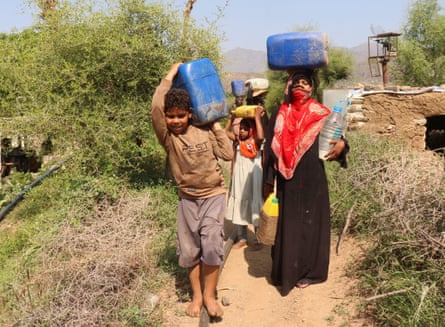
“Studying is important, but not in a situation like this where we are struggling to get enough food, water and other necessities,” he said. “For now, I will keep working until the war ends.”
His father, Ghaleb Farie, has been forced to ask his sons to work so that the family can scrape together enough to survive life in the displacement camp. Farie hopes the camp will be only a temporary home and that he can soon return to his village, but he is not optimistic as new displaced people arrive every day.
“What I was told by neighbours who have been displaced for longer is that the first few months are difficult and I will adapt,” Farie said.
Life has also grown harder for those who have remained in their homes. Abdulwasea Abdu, the principal of Musaab Ibn Umayr school in Taiz, tried to keep the doors of his school open for as long as possible to give children a sense of normality. But that normality was shattered two weeks ago when a missile fell nearby, exploding in sight of the students.
“On the day the missile struck, we witnessed severe panic among them, with crying and screaming due to the explosions. Some children showed psychological trauma as a result of the intensity of the blasts,” Abdu said.
The school was forced to close its doors, depriving the more than 600 pupils of their education. Abdu watches the battlefield developments closely, searching for a let-up that will let him resume classes, but so far the situation has been too chaotic.
“The area faces fighting from multiple fronts – south, west and north – which makes it difficult to take any steps toward resuming classes at the moment,” Abdu said. He fears that many of the children out of school and displaced will be forced into child labour.
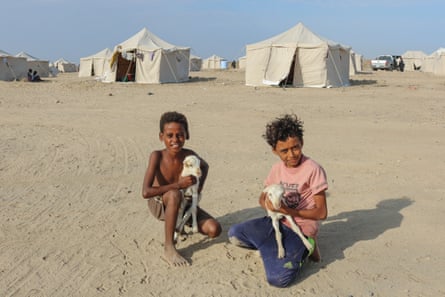
The resumption of fighting has upended life for residents of south-west Yemen. Clashes severed the main road between the now Houthi-controlled port city of Mocha and government-controlled Taiz. The road is a vital artery for goods as it is one of the only in the area wide enough for large trucks and passenger buses.
Interrupted commerce has increased the price of basic goods, compounding the crisis, particularly for displaced people.
“It is civilians who bear the cost of military escalation, and it seems that we in Taiz are paying a particularly heavy price, as commodities no longer reach us easily,” said Essam Nabil, a 56-year-old carpenter in Taiz city. He added many people had begun giving up meat and resorting to cheaper foods.
The fighting has disrupted other, more mundane facets of daily life. Asaad, an expatriate who works in Saudi Arabia and asked to be identified only by his first name, can no longer take a direct trip back from Yemen.
“This reminds me of the early years of the war in Taiz, when the main roads were blocked and we had to travel through Aden before heading to Saudi Arabia,” Asaad said. “Now, we are repeating the same expensive and arduous journey.”