Europe’s tallest Virgin Mary statue unveiled in small Polish village
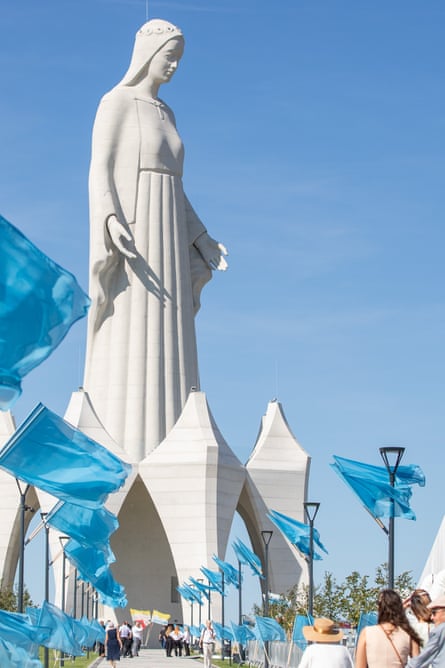
An enormous statue of the Virgin Mary that is believed to be Europe’s tallest was inaugurated on Saturday in a small Polish village, in the presence of the anti-communist leader Lech Wałęsa.
Hundreds of people took part in the consecration of the monument, which towers 55.6 metres (182ft) over Konotopie in central Poland, a village of fewer than 150 people.
While helicopters scattered miniature red roses over the crowd, priests in white robes celebrated mass and the Mazowsze folk ensemble sang and danced to traditional Polish music.
The statue is taller – if less dramatically located – than the Christ the Redeemer statue in Rio de Janeiro, Brazil, which measures 38 metres including its pedestal. The Polish monument’s height includes a crown-shaped 15-metre pedestal.
It also surpasses another large-scale religious monument in Poland, the Christ the King statue in the western town of Świebodzin, which was revealed in 2010 and, with the mound it stands on, is 52.5 metres tall.
There is a taller statue of the Virgin Mary in the Philippines, which measures 98 metres. But the new one in Poland is believed to be the largest of its kind in Europe.
Wałęsa, who won the Nobel peace prize for his leadership of the Polish anti-communist resistance as the head of the Solidarity trade union and was later Poland’s president, had a front-row seat during the inauguration ceremony.
“This is the end of my path,” said Wałęsa, 82, suggesting the causes he had long championed, including democracy and the Catholic faith, were now completed. “I started with the Virgin Mary and I end with the Virgin Mary.”
During his Solidarity days, Wałęsa famously wore a Black Madonna pin and he has often credited his faith in God with giving him the strength to fight against communism.
Most Poles identify as Catholic. The church played a powerful role in public life after the fall of communism in 1989, benefiting from the prestige it earned through its support of the anti-communist opposition.
The country is the homeland of Saint John Paul II, who was pope from 1978 until his death in 2005. A huge statue of him – but much smaller than the one of Mary – was revealed more than a decade ago in the city of Częstochowa.
The influence of religion in public life has gradually declined in recent years, particularly among younger people and in urban areas. However, the Catholic church remains influential, especially in rural communities and among older generations.
after newsletter promotion
Wiesław Mering, a Polish Roman Catholic prelate who attended the ceremony, said: “I cannot help but notice the weakening of the institution of the church, a withdrawal of specific social categories from Catholicism, and this hurts me. The history of Christianity has ups and downs, but this place is a reminder that Mary won’t give up on Poland.”
The statue was commissioned by Roman Karkosik, a wealthy Polish businessman, and his wife, Grażyna. The couple live in a small palace a few miles from Konotopie.
Roman Karkosik, an entrepreneur whose ventures included plastic bottle manufacturing in the 1990s, amassed a fortune through investments on the Warsaw stock exchange to become one of Poland’s wealthiest individuals.
The couple have said the monument is an expression of their gratitude to God. “The statue will be for all people,” Grażyna Karkosik said. “Each of us coming to see it will think more deeply about their own lives, not only about God.”
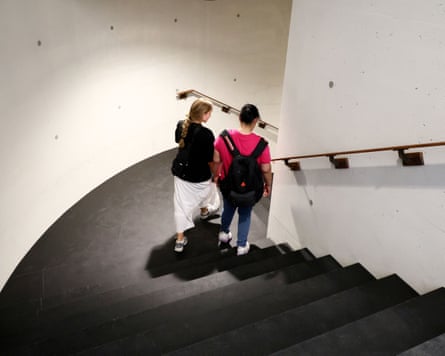
Local authorities hope the monument will become an important pilgrimage site and a tourist destination. The statue has a viewing platform built inside its pedestal.