Extreme temperature warnings in place as ‘heat dome’ bakes US
Extreme heat warnings are in place for large swaths of the United States this week, as an unusual weather pattern eclipses record temperature highs.
In Billings, Montana, residents experienced a sweltering 111F (43.9C) on Sunday, the hottest day in its history. Salt Lake City in Utah also hit an all-time record high on Sunday at 109F. Boston has seen more 90F days than average, according to NPR station WBUR-FM.
The high temperatures have been attributed to a “heat dome”, a phenomenon where pressure in the atmosphere traps heat over a region for a prolonged period of time, suppressing clouds and storms and causing hot and dry conditions, according to Cara Schulte, a researcher at the advocacy group Climate Rights International.
The heat has not subsided at night in certain parts of the midwest and north-east. That lack of night-time cooling compounded with daytime heat can increase the risk of heat illnesses or cardiovascular strain for vulnerable groups, including older people, Schulte said.
The heatwave comes amid a deadly wildfire season. In late June, three firefighters were killed as they fought to suppress a blaze along Colorado and Utah’s border. This week, a helicopter pilot responding to a fire in Colorado died after his aircraft crashed under circumstances that remain unknown.
According to the National Interagency Fire Center, there are now dozens of wildfires burning in states including California, Oregon, Colorado, Utah, Minnesota and Idaho.
Meanwhile, heavy smoke from more than 100 wildfires burning in Canada have given Toronto the worst air quality in the world, with winds pushing the pollution south into the US.
Warnings about dangerous, unhealthy air on Wednesday extended from Minnesota into New York City, where unusually hot summer temperatures were also expected.
The best advice is to stay indoors to avoid both the smoke and the extreme heat, said Tyler Hasenstein, meteorologist with the National Weather Service in Chanhassen, Minnesota.
“Those two things coinciding with each other is not good from a health perspective,” he said.
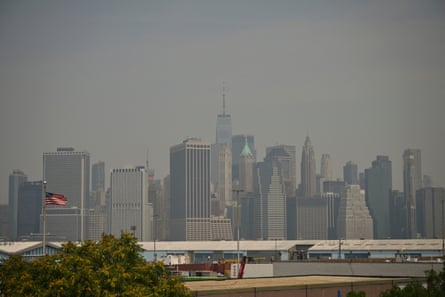
Severe drought and heat have already led to a busy wildfire season. Fires this year have scorched about 3.6m acres of land to date, according to the National Interagency Fire Center.
“Heatwaves like this one dry vegetation across the west, turning them into kindling, until a single spark can become a climate disaster,” said Trevor Stankiewicz, another researcher at Climate Rights International.
Dan Westervelt, associate professor at Columbia University’s climate school, said severe drought conditions combined with heat in Canada and the US have created “a perfect storm for really dry conditions to provide a lot of fuel for these wildfires to burn”. Research shows warming temperatures from burning coal, oil and gas are making fires more frequent and intense.
“Heat creates the perfect conditions for fire. Hot and dry weather dries out vegetation and makes it more flammable. Once a fire starts, these types of conditions can cause the fire to grow more quickly and make containment much more challenging,” Schulte said.
In far north-east Minnesota, rangers were trying to warn people the Boundary Waters Canoe Area Wilderness was closed because about 17 fires caused by lightning were burning around the vast wilderness accessible primarily by canoe.
The area was closed Tuesday and rangers estimated anywhere from 6,000 to 10,000 people were still inside the 1.1m-acre (445,000-hectare) wilderness, which is almost the size of Delaware, Joy VanDrie, Superior national forest spokesperson, said.
“It’s an arduous job,” VanDrie said of rangers and campers having to canoe for hours or even carry their boats over land to evacuate.
The National Oceanic and Atmospheric Administration has forecast heat hazards to persist through next Monday. The agency predicts California and several upper midwest states will be at risk of dangerous heat levels for the first half of this week.
High temperatures are expected to blanket areas in the south later in the week.
Officials have warned the public to be on alert for symptoms of heat-related illnesses, which arise when sweltering heat interferes with the body’s ability to cool itself.
Heat exhaustion, for example, can present in symptoms such as profuse sweating, clammy skin and fatigue, according to the National Weather Service. Meanwhile, heatstroke, a medical emergency, can cause slurred speech, a rapid pulse and body temperature over 103F, per the agency.
The Associated Press contributed reporting