‘It’s a good start’: prominent Israelis welcome UK sanctions on illegal settlements
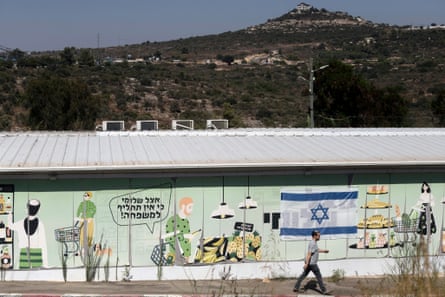
Prominent Israelis have welcomed new UK sanctions as a necessary response to settlement expansion and spiralling violence in the occupied West Bank.
The intervention was described – by the president of the Israel Academy of Sciences and Humanities, a former prime minister, an ex-head of the army and former ministers and diplomats – as an “inevitable consequence” of Israeli government and security failures.
“Sanctions [are being imposed] against Jewish terrorists, and not against the legitimacy of the state of Israel,” they wrote in a joint statement. “There is no basis to the [Israeli] government’s response that the decision to impose sanctions against Jewish terrorists is an expression of antisemitism.”
Ed Miliband, the foreign secretary, had indicated Britain was planning new sanctions but the strength of his language and the scale of the controls he announced on Tuesday were a surprise.
It was the most significant attempt in many years, from a close Israeli ally, to leverage economic power to force change in the occupied West Bank.
“Israel’s government has caused a rupture in the longest-standing diplomatic convention of all: using obfuscation and plenty of ‘very concerned’ statements instead of actually doing anything,” Esther Solomon wrote in the Haaretz newspaper.
The impact was multiplied when France and Canada announced plans for trade bans on settlement goods and 10 other European countries backed similar measures. Nor did any senior figure in the Trump administration, which was briefed in advance on the UK plans, criticise the measures.
“Jerusalem had prepared for rain, but what arrived yesterday was a full-blown storm,” Itamar Eichner wrote in Yedioth Ahronoth. “Yesterday Israel was caught off guard, to the point that senior Israeli officials used the term ‘an intelligence-diplomatic failure’.”
Nearly three-quarters of Jewish Israelis favour partial or total annexation of the occupied West Bank, a poll for the Jewish People Policy Institute found. All leading candidates in the upcoming election reject a Palestinian state.
However, there is increasingly vocal opposition to settler violence and expansion from some members of the country’s security, political and cultural elites. They threatened legal action against their government this summer over its support for Jewish terrorism and an “ideology of ethnic cleansing” in the occupied West Bank.
Prof David Harel, British-born president of the Israel Academy of Sciences and Humanities, is among those who signed a statement backing the UK measures.
He said the sanctions offered urgently needed support for Israelis like him, who are trying to stop attacks on Palestinians and end the occupation.
“I personally would fight until my last breath against antisemitism and against anti-Israelism. For that reason, I’m against general wall-to-wall boycott, divest, sanction-style sanctions on the state of Israel,” the leading scientist told the Guardian.
“But what is justified, and I do support, is being anti things that Israel is doing, and these days in particular what it is doing in the West Bank.”
He said that Israelis calling for a delay until after the elections were ignoring both the escalating violence that Palestinians faced every day and the risks the occupation posed to Israel’s future.
“Getting out of there [occupied Palestine], or, at least for the present, stopping these things from happening and starting to really talk about a two-state solution is not only good for the Palestinians. It’s not that we’re doing these poor people a favour. We’re doing a favour to ourselves, no less, maybe even more.”
The joint statement backing the UK sanctions was also signed by former prime minister Ehud Olmert, former commander of the Israeli military Dan Halutz, former ministers Yuli Tamir and Roni Bar-On and former ambassador to Germany Yoram Ben Zeev.
“This decision is precisely what the state of Israel should have received in order to remove the disgrace of Jewish terrorism from the face of the country,” they wrote.
Nadav Tamir, a former diplomat, also described the measures as good for Israel.
“Any move to prevent annexation and ethnic cleansing of the Palestinians in the West Bank [and Gaza] is serving the long-term interests of the Zionist vision of Israel as the democratic homeland of the Jewish people,” he said. “It will help us to be more secure and moral.”
The value of goods exported from occupied territories to Britain last year was only $45m (£33m) out of total $4.4bn trade in goods and services, according to Roey Fisher, head of Israel’s Foreign Trade Administration.
However, plans to place sanctions on any company that finances or facilitates settlement expansion could force Israel’s main banks and insurance companies to choose between their business interests in the UK and those in occupied Palestine.
Miliband has not provided details of the new measures but the move has the potential to slow or stop construction.
Avraham Burg, a former speaker of the Knesset, thanked Miliband for setting a global example. “Like many Israelis and Palestinians I am grateful for the courageous moral leadership of Miliband. It’s a good beginning. Do not stop,” he said.
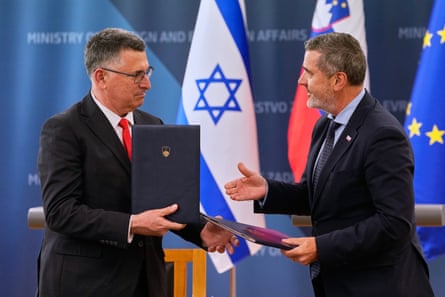
But Israel’s foreign minister, Gideon Sa’ar, attacked Miliband for “blatant interference” in his country’s domestic affairs before a late October election. Opposition politicians suggested instead that Benjamin Netanyahu might weaponise the UK sanctions to bolster his campaign to remain prime minister.
Dahlia Scheindlin, one of Israel’s leading political analysts, said the UK move was very unlikely to affect the October election, because Israeli voters were more focused on domestic issues.
“Since 7 October [2023], Israel has become much more inward-looking and provincial, and generally the attitude to the rest of the world is just that ‘they all hate us’,” Scheindlin said.
“If you are a Netanyahu supporter you might take this as evidence that they are against us because of antisemitism, and if you are in the opposition camp you might take this as further evidence that the world is turning against us because of Netanyahu’s policies. But it’s hard to see how these policies change the breakdown of the electoral map.”
Miliband made his speech on a day when political parties finalised their candidate lists and Haaretz had a bombshell story about security warnings delivered to Netanyahu – and apparently ignored – before the 7 October attacks.
Fourteen Israeli human rights organisations welcomed the sanctions. “This is an important and necessary first step to meet states’ legal obligation,” said the statement from groups including B’Tselem, Physicians for Human Rights Israel and Breaking the Silence.
“We urge the international community to take further concrete measures to ensure that its relations with Israel no longer enable Israel’s settlement enterprise, forced displacement and ethnic cleansing in the occupied West Bank, or its broader assault on Palestinian human rights across all territories under its control.”