Middle East crisis: Funeral procession for supreme leader Ali Khamenei begins in Iran – as it happened
From
6 Jul 2026Millions assemble in Tehran to mourn supreme leader, calling for revenge against US

Patrick Wintour
Good morning, and welcome to the Middle East live blog.
Today marks the start of a mass funeral procession for Iran’s former supreme leader, Ali Khamenei.
Millions have assembled in the capital for the six-day, five-city funeral for Khamenei, who was killed in February during the first airstrike when the US and Israel started the current war in the region. He was succeeded by his son, Mojtaba Khamenei.
Guardian correspondent Patrick Wintour is on the ground reporting from Tehran. He said the funeral prayers this weekend ‘created a political spectacle at Tehran’s Imam Khomeini Grand Mosalla that melded grief with calls for revenge.’
You can read his latest update here:
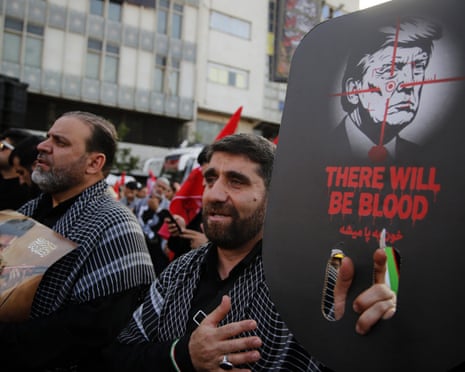
The procession today follows two days of public farewell ceremonies, during which there were calls for the murder of Donald Trump.
The coffins of Khamenei and family members also killed in the strikes will make their way to Mehrabad International Airport over the course of a 12-hour journey.
Daily life has ground to a halt since national mourning began on Saturday, with authorities closing streets and air space to mark the occasion. The procession will end on Thursday, when Khamenei will be buried at the Imam Reza shrine in Mashhad, where he was born.
We’ll follow the procession as it makes its way through Tehran, and also give you the latest on hostilities which are continuing in Lebanon and Palestine.
Key events
6 Jul 2026
Closing summary
6 Jul 2026
Hamas announces it is ready to hand over leadership to a UN-backed committee
6 Jul 2026
Iran's new supreme leader has not appeared in public for his father's funeral
6 Jul 2026
Millions assemble in Tehran to mourn supreme leader, calling for revenge against US
Closing summary
-
Today marked the start of a mass funeral procession for Iran’s former supreme leader, Ali Khamenei. Millions have assembled in the capital for the six-day, five-city funeral for Khamenei, who was killed in February during the first airstrike when the US and Israel started the current war in the region.
-
Several officials who haven’t been seen since the start of the war have made a rare public appearance for the funeral procession. Former president Mahmoud Ahmadinejad was seen during the day in what seems to be his first major public appearance since fighting broke out with the US and Israel. The new commander of Iran’s Revolutionary Guards, Ahmad Vahidi, attended the funeral as well as the procession, and so did Esmail Qaani, who leads the Guards’ Quds Force which oversee foreign operations.
-
President Donald Trump said earlier today that the United States will either make a deal with Iran or “finish the job.” He told reporters that he would rather make a deal.
-
Hamas is dissolving the body that has governed the Gaza strip since 2007 and handing over control to a technocratic committee established by Trump’s Board of Peace. The National Committee for the Administration of Gaza is a temporary governing body set up under the Board of Peace to oversee civilian affairs. It was launched in January this year, as part of a ceasefire deal made in October 2025.
-
Lebanon’s president has said that Israel’s occupation of the south was preventing the Lebanese army’s deployment to the area, as the two sides prepare to implement a deal involving the deployment and gradual Israeli withdrawal. According to a statement from his office, president Joseph Aoun emphasised the need to pressure Israel to withdraw its forces “because the persistence of the occupation undermines the legitimacy of the [Lebanese] state and prevents the army from deploying and the laying of the foundations for achieving a just and lasting peace”.
-
Israeli prime minister Benjamin Netanyahu on Monday urged the United States not to sell its F-35 fighter jets or components to Turkey, arguing it would “upset the power balance” in the region. US president Donald Trump travels later on Monday to Ankara for a Nato summit, and his visit could be seen by the Turks as an opportunity to secure acquisition of dozens of jet engines and potential readmission to the F-35 fighter jet program, AFP reports.
-
Lebanese state media said an Israeli strike on a car in the country’s south on Monday killed four people, including three women, despite a fragile ceasefire between Israel and Hezbollah. Lebanon’s official National News Agency (NNA) said a school principal, her mother, a foreign female domestic worker and a male Syrian worker were killed when “an Israeli drone targeted the car” they were travelling in as they returned from inspecting their family home in Nabatieh al-Fawqa.
-
A British charity is funding a religious school at the heart of expansion plans for the illegal Israeli settlement in the Palestinian city of Hebron. Friends of Yeshivat Shavei Hevron sent nearly £200,000 to the school between 2019 and 2024, the last year for which accounts are publicly available on the website of the Charity Commission, the charity regulator for England and Wales.
President Donald Trump said earlier today that the United States will either make a deal with Iran or “finish the job.”
He told reporters that he would rather make a deal.
Israeli prime minister Benjamin Netanyahu on Monday urged the United States not to sell its F-35 fighter jets or components to Turkey, arguing it would “upset the power balance” in the region.
US president Donald Trump travels later on Monday to Ankara for a Nato summit, and his visit could be seen by the Turks as an opportunity to secure acquisition of dozens of jet engines and potential readmission to the F-35 fighter jet program, AFP reports.
The Israeli prime minister however warned that it would be a mistake for Washington to reward Turkish president Recep Tayyip Erdogan, whom Netanyahu said “calls openly for the annihilation of Israel,” with advanced military technology.
“I don’t think they should be given F-35s or the engines for their fighter jets, because that’ll upset the power balance in the Middle East, which is ultimately guaranteed by Israeli air superiority and also by, I think, by America’s posture in the Middle East,” Netanyahu told Fox News morning show Fox + Friends.

Emma Graham-Harrison
A British charity is funding a religious school at the heart of expansion plans for the illegal Israeli settlement in the Palestinian city of Hebron.
Friends of Yeshivat Shavei Hevron sent nearly £200,000 to the school between 2019 and 2024, the last year for which accounts are publicly available on the website of the Charity Commission, the charity regulator for England and Wales.
Construction of a new dormitory for the school was approved in June, after the far-right finance minister, Bezalel Smotrich, unilaterally broke a decades-old international agreement on control of Hebron to give Israel planning authority.
The expansion will increase the population of one of the most extreme Israeli communities in the occupied West Bank, and the only one built in the heart of a Palestinian city.
“We want British charities to fund peace, not to fund obstacles for peace. This is very wrong,” said Issa Amro, a Palestinian human rights defender from Hebron and co-founder of Youth Against Settlements. “The students at this Yeshiva are very aggressive. A new building will mean more violence towards Palestinians, more restrictions, more Israeli military presence.”
Emma Graham-Harrison
Meanwhile, Emma Graham-Harrison, Lorenzo Tondo and Sufian Taha have a story on one of Gaza’s most prominent doctors, who is almost unrecognisable from his injuries in Israeli detention, his lawyer said.
Abu Safiya has been held for 18 months without charge or trial. The reporters write:
double quotation markAbu Safiya had become the face of health workers struggling to treat patients throughout the war in Gaza before his detention. He is being held indefinitely, along with thousands of other Palestinian civilians, in prisons that Israeli rights groups say have become torture camps.
Hamas announces it is ready to hand over leadership to a UN-backed committee
Hamas is dissolving the body that has governed the Gaza strip since 2007 and handing over control to a technocratic committee established by Trump’s Board of Peace.
The National Committee for the Administration of Gaza is a temporary governing body set up under the Board of Peace to oversee civilian affairs. It was launched in January this year, as part of a ceasefire deal made in October 2025.
“Hamas has taken a new step in that it will no longer be in charge of the Strip, in order to remove any pretexts for the occupation, which continues its aggression and war of extermination,” Hamas spokesman Hazem Qassem told AFP.
On the social media platform X, the Board of Peace’s account said they had taken note of the announcement, but that ‘our assessment will be guided by actions, not promises.’
The issue of disarmament continues to be a live issue, with the Board also saying: ‘The core principle remains one authority, one law and one weapon. This means the consolidation of all weapons under the control of the NCAG.’
Lebanese state media said an Israeli strike on a car in the country’s south on Monday killed four people, including three women, despite a fragile ceasefire between Israel and Hezbollah.
Lebanon’s official National News Agency (NNA) said a school principal, her mother, a foreign female domestic worker and a male Syrian worker were killed when “an Israeli drone targeted the car” they were travelling in as they returned from inspecting their family home in Nabatieh al-Fawqa.
Israel has kept up intermittent strikes on south Lebanon, particularly in the Nabatieh area, despite the two-week-old truce, usually saying it is targeting Hezbollah sites and operatives, with both sides accusing the other of violations.
Meanwhile, Lebanon’s president has said that Israel’s occupation of the south was preventing the Lebanese army’s deployment to the area, as the two sides prepare to implement a deal involving the deployment and gradual Israeli withdrawal.
According to a statement from his office, president Joseph Aoun emphasised the need to pressure Israel to withdraw its forces “because the persistence of the occupation undermines the legitimacy of the [Lebanese] state and prevents the army from deploying and the laying of the foundations for achieving a just and lasting peace”.
Today’s procession marks a contrast with the funeral for Iran’s previous supreme leader in 1989, which devolved into chaos.
According to official estimates at the time, more than 10 million people attended the funeral of Ali Khamenei’s predecessor, Ruhollah Khomeini – that’s around a sixth of the country’s population, with the Guinness World Records marking the event as the largest proportion of a country to attend a funeral.
When mourners stormed the vehicle carrying Khomeini’s body, authorities had to use a helicopter to transport him for the burial. Crowd surges killed at least eight people and injured more than 10,000.
Several officials who haven’t been seen since the start of the war have made a rare public appearance for the funeral procession.
Former president Mahmoud Ahmadinejad was seen during the day in what seems to be his first major public appearance since fighting broke out with the US and Israel.
The new commander of Iran’s Revolutionary Guards, Ahmad Vahidi, attended the funeral as well as the procession, and so did Esmail Qaani, who leads the Guards’ Quds Force which oversee foreign operations.
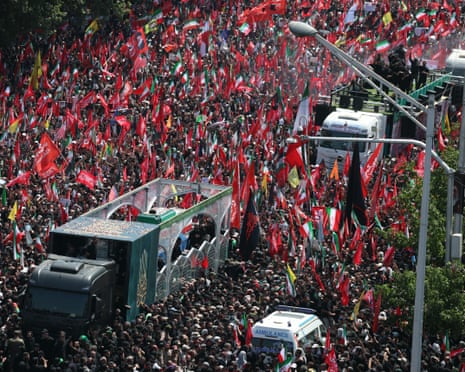
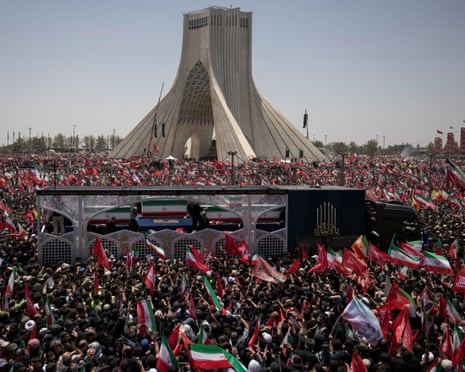
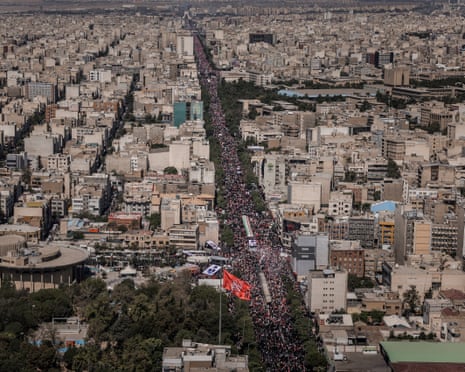
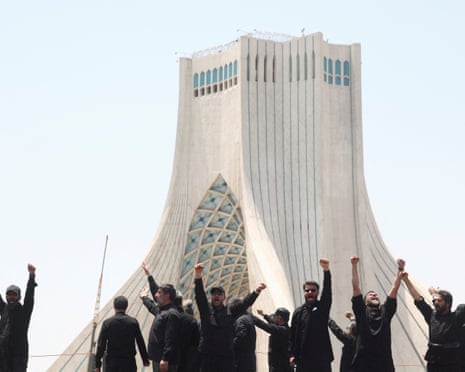
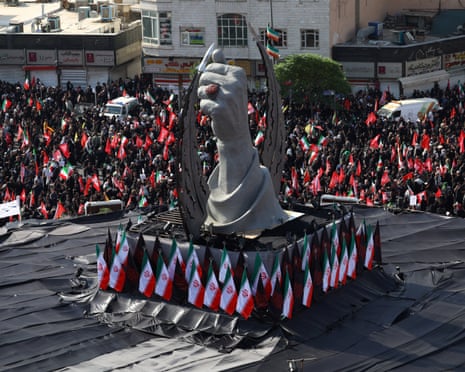
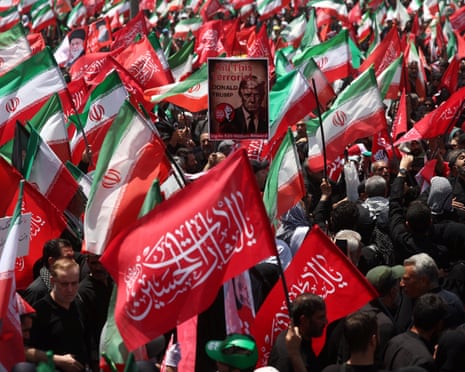
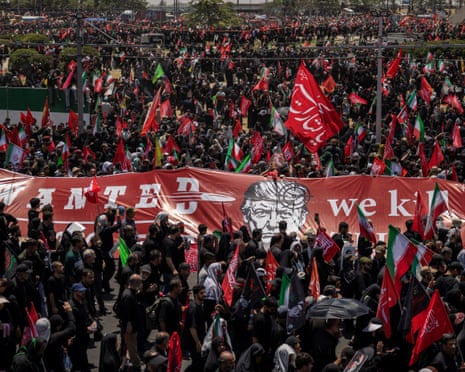
Mass funeral procession for Iran’s former supreme leader travels across Tehran - in pictures
Aliyah Abdel Majid al-Halaq
Aliyah Abdel Majid al-Halaq is the mother of Mohammad, who was killed by Israeli forces last year when he was nine years old. She writes:
‘At first, you believe your tragedy is unlike any other. Then you discover that your family has become part of an ever-growing list. More mothers, each carrying the memory of the moment after which life was never the same.’
Philip Goodwin, who leads UNICEF UK, writes that Mohammad’s story ‘resonated deeply’ after travelling to the West Bank to meet Palestinian families there.
‘I have worked in humanitarian development for more than two decades, but nothing could have prepared me for what I witnessed there,’ he says. You can read his letter here:
Patrick Wintour
Here are some more details from Patrick Wintour, who’s in Tehran at the moment reporting on the days of national mourning for Khamenei.
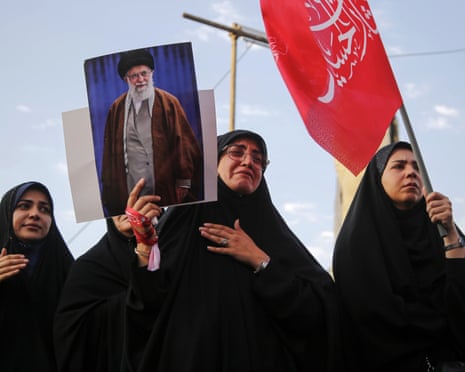
The funeral procession, believed to be millions strong, has moved from east to west of the city, from Revolution Square to Azadi Square.
Alongside grief for the supreme leader, the days of national mourning have also been marked by a desire for vengeance, with the words ‘Kill Trump,’ chalked on the stage by mourners at the funeral on Sunday.
Wintour writes:
‘In a feat of organisation by the state authorities and the volunteer civic army that fed and housed the mourners, no one was killed – unlike at previous state-linked funerals that rapidly descended into chaos, including that of the previous supreme leader.
The Iranian president praised the crowds’ behaviour and expressed hope that the images emerging from Iran would force the west to reflect on its determination to change Iran.’

Dan Sabbagh
Guardian defence and security editor Dan Sabbagh has a story today on how Israel identified around 1,000 potential targets a day in Gaza and Lebanon during the first two years of the war. He writes:
‘A total of 850,000 targets were detected in real time by the Israeli Tzayad digital army programme across all the military’s theatres of war between 7 October and the end of 2025, the company said at a military conference in London.’
Sabbagh also has comment from a former senior targeting adviser and policy analyst at the US Pentagon, who said the 850,000 figure was highly concerning.
You can read the full story here:
Iran's new supreme leader has not appeared in public for his father's funeral
So far, Khamenei’s son and Iran’s new supreme leader, Mojtaba Khamenei, has not been seen at the events marking the days of national mourning.
Three of the former leader’s sons were present during the second day of the funeral, and were seen praying behind the coffins of their family members.
The new supreme leader has not been seen or heard in public since he was appointed to his position in March, which is widely believed due to be because of security concerns.
According to the Times of Israel, Israel defence minister Israel Katz has warned that Iran’s new leaders could meet the same fate as Khamenei, saying that “any Iranian leader who tries to push plans to destroy Israel again will also be thwarted.”
Millions assemble in Tehran to mourn supreme leader, calling for revenge against US
Patrick Wintour
Good morning, and welcome to the Middle East live blog.
Today marks the start of a mass funeral procession for Iran’s former supreme leader, Ali Khamenei.
Millions have assembled in the capital for the six-day, five-city funeral for Khamenei, who was killed in February during the first airstrike when the US and Israel started the current war in the region. He was succeeded by his son, Mojtaba Khamenei.
Guardian correspondent Patrick Wintour is on the ground reporting from Tehran. He said the funeral prayers this weekend ‘created a political spectacle at Tehran’s Imam Khomeini Grand Mosalla that melded grief with calls for revenge.’
You can read his latest update here:
The procession today follows two days of public farewell ceremonies, during which there were calls for the murder of Donald Trump.
The coffins of Khamenei and family members also killed in the strikes will make their way to Mehrabad International Airport over the course of a 12-hour journey.
Daily life has ground to a halt since national mourning began on Saturday, with authorities closing streets and air space to mark the occasion. The procession will end on Thursday, when Khamenei will be buried at the Imam Reza shrine in Mashhad, where he was born.
We’ll follow the procession as it makes its way through Tehran, and also give you the latest on hostilities which are continuing in Lebanon and Palestine.