‘Of course I’m the underdog’: the British former spin doctor trying to turn California red
Steve Hilton stands almost no chance of becoming California’s next governor, but that isn’t stopping him from campaigning as though he was just one step away from pulling off the impossible.
The former Downing Street political adviser and Fox News host refuses to be daunted by the rancid political environment for Republican candidates this year, or by opinion polls that tell him he is lagging 20 percentage points or more behind his Democratic rival, Xavier Becerra.
Instead, as he barnstorms the state in an effort to rally the Republican faithful and win over as many Democrats and independents as he can find, he is following a full-throated people-versus-the-powerful script and pumping out what he hopes will be crowd-pleasing policy proposals as fast as he can come up with them.
Abolish the department of motor vehicles, he suggested a couple of weeks ago. Cut the price of gas to $3 a gallon. Start a new business school in working-class East Los Angeles. Set up a competition among California’s 58 counties to build 10 brand-new cities from the ground up.
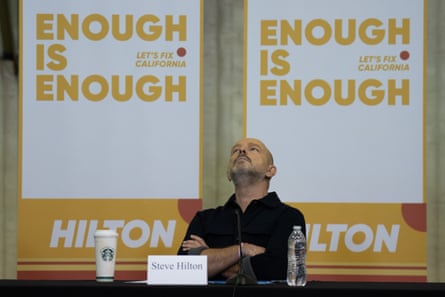
Many of these ideas dovetail with the argument Hilton has made from the day he started running, that California has been driven to the brink of ruin by 16 years of Democratic party control over every statewide office. “Enough is enough,” as his campaign slogan says.
But they also mark a return to his roots as a prolific and occasionally unpredictable political ideas man, known during his time working for the British Conservative party for spitting out proposals while wandering barefoot through the corridors of power.
‘Un-pigeonhole-able’?
Policy has been one of the few throughlines in Hilton’s unconventional political journey from one side of the Atlantic to the other. He’s been a restaurant owner and business consultant as well as a senior adviser in the coalition government led by David Cameron in the 2010s. He came to California largely because his wife, Rachel Whetstone, established herself as a big tech public relations guru in Silicon Valley.
For many years, Whetstone was considered the power in the couple, while he wrote a couple of policy books – about “positive populism” and putting a human face on government – and used his connections in the conservative movement to land his Fox News show. Seizing the chance to try to resuscitate a largely moribund California Republican party came only much later.
Hilton prides himself on being “un-pigeonhole-able” and thinks of his campaign style as some combination of three startlingly different recent presidential candidates – Bernie Sanders, for his unwavering commitment to lift up struggling people; the Kentucky senator Rand Paul, for his fondness for libertarian free-market solutions; and John Kasich, the former governor of Ohio, for his “happy warrior” campaigning style.
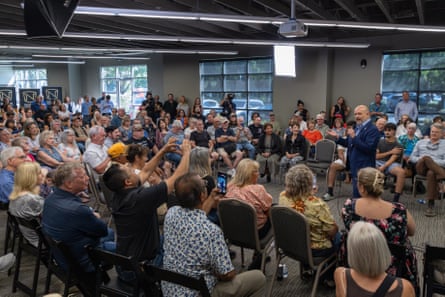
Many of his ideas come straight out of the Republican playbook, accounting for the mistrust he inspires in many Democratic voters. He wants to set up a California version of Doge, Elon Musk’s so-called department of government efficiency that took a hatchet to federal agencies in the opening months of Trump’s second presidency. He wants to kill several environmental regulations, including a plan to introduce more energy-efficient vehicle tires over the next decade. (Hilton calls the energy commissioner who came up with the idea a “tire-rant”).
He also wants to cancel big, expensive public works projects starting with the long-delayed high-speed train from San Francisco to Los Angeles, which Hilton, in common with other Republicans, calls “the bullshit train to nowhere”.
Many of his other proposals, though, are harder to define: a plan to eliminate state taxes on the first $150,000 of income, which echoes similar proposals from some of Becerra’s more progressive Democratic primary challengers; the business school plan, which would offer free tuition to lower-income students; or a plan to turn the highway patrol into a full-fledged statewide police investigation force “liberated” from the DMV that currently finances it.
Still, Hilton is a savvy and appealing communicator, with a keen understanding of what frustrates and infuriates ordinary Californians. He acknowledges that his more outlandish ideas are unlikely to win this or any other election. But he believes they tell voters he is a pragmatic, independent thinker who, in an age of extremes and polarized political discourse, can talk to anyone, negotiate with anyone, and can entertain any good idea as long as it makes people’s lives easier and lifts the burden of government inefficiency and bloat.
He knows that California voters of all political persuasions are frustrated by the daily struggle of keeping up with soaring food and gas prices and looking for solutions to an array of social ills from homelessness to dwindling access to healthcare. It’s a big part of the reason why he led the polls for much of the primary campaign and ended up a close second behind Becerra in a crowded field.
“I’m not ideological,” he likes to say. “I’m not tribal.”
The ‘T’ problem
A major problem for him, though, is that he belongs to a party in thrall to “the president whose name begins with T”, as Hilton calls him – a leader whose name is particularly toxic in California, where registered Democrats outnumber Republicans by a two-to-one margin, and, this year, is dragging down Republican candidates across the country.
That has greatly complicated his quest to convince Californians that, by shrinking the size of the state government and slashing what he sees as over-burdensome regulations on small businesses, he can make the state more affordable for ordinary people. However encouraging it was to win close to 25% of the primary vote in June, building up another 25% of the vote in the general election has proven daunting.
And Hilton knows it. “Of course I’m the underdog,” he said. “Of course it’s an uphill battle. People are out of the habit of voting Republican. Still, I see a narrow but real path to victory. I see winning.”
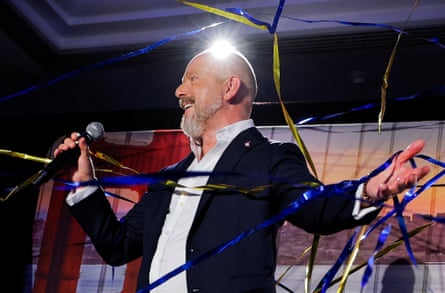
Often, Hilton finds himself walking a fine line between indulging California’s Trump diehards, a vital part of his base, and broadening his appeal. He has made clear he doesn’t want Donald Trump or any other national Republican figure to campaign for him. He has distanced himself from Trump’s complaints of a “rigged system” and sees no need to restrict mail-in voting. But he has talked in the past of being friends with half of Trump’s cabinet and earned Trump’s endorsement during the primary, making it difficult to put much distance between himself and the man in the Oval Office.
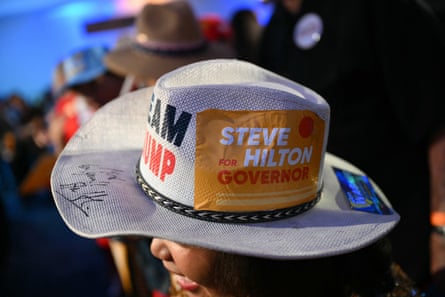
When facing crowds of the Republican faithful, as he did during the primaries and continues to do at town halls up and down the state, his non-tribal bona fides are quickly tested by supporters eager to talk about Democrats stealing elections, conspiring to take away gun rights, and unjustly prosecuting insurrectionists who attacked the US Capitol on January 6, 2021.
At a recent event in San Gabriel, in the eastern Los Angeles suburbs, Hilton did nothing to discourage such talk. Rather, he milked several applause lines by promising to be a champion for such supporters once he was in office. “I’ve never said anything I don’t believe,” he explained in an interview shortly before the event. “I just don’t say everything that I believe.”
Away from the Maga faithful, Hilton has made the case that California’s problems have far more to do with the Democrats than with the occupant of the Oval Office. “You don’t have to like Trump. You don’t have to become a Republican,” he wrote in an unusual full-page advertisement that ran in the Los Angeles Times and the San Francisco Chronicle in July. “You just have to ask yourself: does it make sense to vote the same way and expect a different result?”
On the campaign trail, Hilton likes to point out that California sees more people moving to other states each year than it receives in new residents. This trend goes back to Schwarzenegger’s governorship, and has not, in most years, led to an overall decline in the state population because international migrants have made up the shortfall. Still, Hilton has woven it into his stump speech. “In the time Gavin Newsom has been governor, millions have moved out of the greatest state in the greatest nation on earth. That’s a terrible indictment,” he says. “Are they fleeing Trump? I don’t think so. Most of them are fleeing to states run by Republicans.”
The voters Hilton hopes will be most open to such lines of argument are those he sees suffering most acutely from California’s affordability crisis – working-class, non-college educated, many of them Latino. From the early days of his primary campaign, he has sat down with small groups and listened to them talking about the tax and regulatory burdens on their businesses, or the high cost of running a car or truck, or the struggle to find high-quality public schools in non-affluent parts of the state.
Such small-scale campaigning goes against received wisdom in California, where consultants of both parties have traditionally relied on television and internet advertising in the belief that a state of 39 million people is too big to reach any other way. Still, Hilton is betting that by talking to voters who don’t normally get to interact with candidates, he can spread the word that he is personable, willing to listen, and eager to help improve people’s lives.
A race to the finish
Hilton knows his idiosyncratic mix of styles exposes him to mockery, if not actual satire – his shoot-from-the-hip policy ideas were memorably parodied on the British TV show The Thick of It. He recalled, for example, an episode of his Fox News show when he insisted on promoting the distinctly un-Republican virtues of home nursing visits to promote perinatal health. “It was a low-rated segment,” he said.
But Hilton also has faith in his ability to connect to voters – the British accent probably helps – and his talent for a pithy phrase. He can be devastating, for example, when talking about Becerra, who he calls an “empty suit” embodying the very worst of Democratic party complacency.
“The level of disrespect for the process is actually shocking,” Hilton said. “Clearly he assumes he’s just going to coast to victory on the back of the Democratic machine … We keep inviting him to engage with us in different ways, but he keeps citing schedule conflicts. What are these conflicts? He’s not scheduling anything.”
Becerra did eventually agree to one debate with Hilton, set for Wednesday. In response to Hilton’s criticisms, Becerra spokesperson Jonathan Underland said: “Steve is desperate to land his dream job as a talking head on the Fox propaganda network. That’s why he can’t stop saying Xavier Becerra’s name.”
It remains to be seen if the debate can shake some of the Becerra camp’s confidence, but for now Hilton is on track to do worse than Gavin Newsom’s barely remembered Republican challenger from 2022, Brian Dahle, who lost by 18 points. A recent poll from the Public Policy Institute of California showed even independents favoring Becerra by close to a 20-point margin.
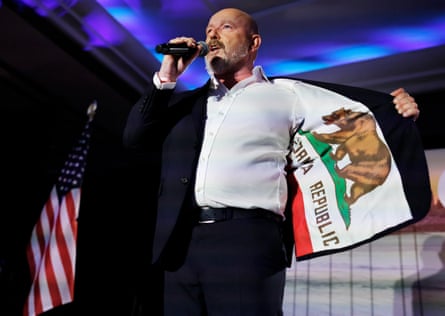
Hilton, though, is refusing to let these numbers bother him as the race enters its final frenetic stretch and his campaign stops become shorter and more intense. On a recent Saturday, Hilton dropped into an Orthodox synagogue in Beverly Hills, where he sported a tallit and a kipa to address a congregation of Iranian Jews for a brisk 10 minutes. On his next stop, 35 miles to the east, he poured exactly one beer and served up one table’s worth of taco plates at a family-owned Mexican restaurant in the foothills of the San Gabriel mountains.
He has learned to spit out his message in small bites, asking a group of tattooed truckers at the Mexican restaurant how they would like it if their annual vehicle registration fee was capped at $73 (part of his DMV abolition plan), then telling a gaggle of Republican women in stars-and-stripes shirts that they needed to copy Democratic get-out-the-vote techniques instead of complaining about the other side cheating.
“This election is not about who you hate in Washington,” Hilton pleaded in his Trump-distancing ad in July, “it’s about what you love here.” His supporters keep telling him he has to win because their livelihoods depend on it. But, so far, the wider California electorate believes the race is indeed about who they hate in Washington – and nothing Hilton does or says seems to be changing their minds.