Spanish mountain village braces for astrotourists lured by total solar eclipse
Little stirs in the mountains above Somosierra beyond the wind that lashes the flat peaks, the cows that graze on parched grass and the sun that beats down on the abandoned aerodrome where generations of glider pilots learned to ride air currents alongside squadrons of vultures and red kites.
But all this stillness will disappear, albeit temporarily, on the evening of 12 August, when swathes of northern and eastern Spain and the Balearic islands experience a total solar eclipse, the likes of which has not been seen here for more than 120 years.
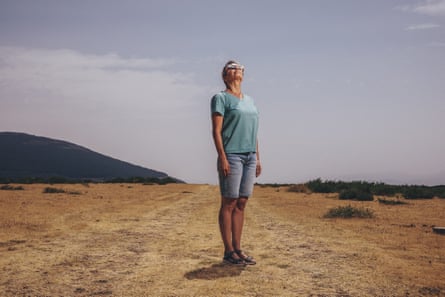
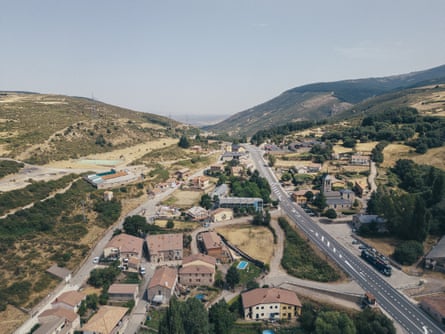
The rare celestial alignment has suddenly turned Somosierra – a small village that sits at an altitude of 1,440 metres where the northernmost reaches of the Madrid region fade into neighbouring Castilla y León and Castilla-La Mancha – into a prime astrotourist destination. No site as close to the Spanish capital will enjoy what Somosierra will: one minute and 29 seconds of pure, clear-skied total eclipse.
Awe-inspiring as the event promises to be, however, it has thrown up all sorts of unexpected but pressing questions for the village and its 93 inhabitants.
With as many as 2,000 visitors expected, where will everyone park? Will there be enough water? And, last but not least, how many batches of paella will the local restaurant need to prepare for the invasion of hungry sky-gazers?
“The fact that we’ve been selected as the best place in the Madrid region to watch the eclipse has led to a huge amount of media and social media coverage,” said Somosierra council’s tourism manager, Irma López Muñoz, as she looked out across the eclipse observation site, a 10-minute drive up past the village.
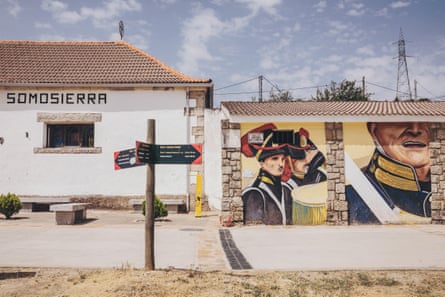
“That’s generated a lot of interest among people in Madrid – and some from abroad. So we’re anticipating a large influx of visitors because it is a unique event that hasn’t been seen for over 100 years.”
Even before the recent massive wildfires broke out to the west of Madrid, Somosierra council was thinking about how to minimise risk factors on the day of the eclipse and has been coordinating its efforts with police and civil protection authorities.
Although the village council has offered 400 official registration slots, it believes five times as many people could turn up on the day.
“We’re very close to a major European capital with a huge population, and many people are going to come without seeking out information beforehand,” added López. “That’s beyond our control. We can’t predict that someone might be watching television and say, ‘Well, I’m going to make some sandwiches and go see the eclipse with my children.’”
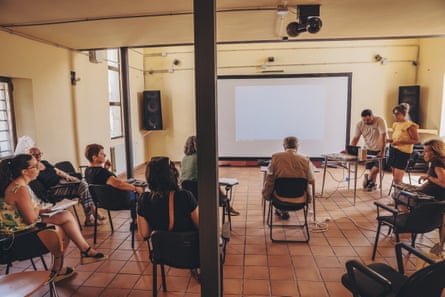
With that in mind, the council is scrambling to recruit and educate volunteers to help steward events on 12 August. It recently hired El Nocturnario, a company of astrotourism experts, to deliver a day’s training to the volunteers who had gathered in Somosierra’s tiny cultural centre to learn about the joys and dangers of eclipses.
One of the volunteers, María Gradaille, said she was delighted to help out with what she called “a once-in-a-lifetime event and a historic scientific milestone”. She was also grateful for the knowledge and the tips she had picked up at the training session.
“I’ve learned so much about the eclipse,” she said. “I didn’t know it could burn your eyes so badly or just how dangerous it can be.”
after newsletter promotion
According to Sarai de la Hoz, one of El Nocturnario’s co-founders, local and regional authorities around Spain are belatedly beginning to wake up the potential benefits of all things astronomical. The looming total solar eclipse will be followed by a six-minute-long “eclipse of the century” in August next year, and by a spectacular “ring of fire eclipse” in January 2028.
Little wonder, then, that the Spanish government has set up a special committee to oversee the trio of eclipses. As the government spokesperson Elma Saiz Delgado pointed out on Tuesday, the events will put Spain “at the centre of global astronomical observation and astrotourism”. This first eclipse alone is expected to attract 446,000 additional visitors in a year when tourist numbers in Spain could pass the 100-million mark for the first time. The event is also forecast to bring in an extra €342m (£292m) in tourist revenue.
“When we started talking about the eclipse a year ago, people kind of thought we were mad. They were like: ‘It’s not going to be that big a deal’ and: ‘Not that many people will come,’” said De la Hoz, “But as time’s gone by and the authorities have realised what’s to come, we’re been getting calls from people who need our help.”
While much of the training she and her colleagues provide is about eclipses and how to watch one safely, the classes also involve a lot of logistics and organisation: “How’s the event going to be organised; who’s going to liaise with the local police and the civil protection authorities, and how will you deal with parking and people at the venue?”
Authorities in the Balearics, which are bracing for huge numbers of extra visitors, have already announced that restrictions will be introduced on 20 main roads across Mallorca, Ibiza, Menorca and Formentera from 3pm until 9pm on the day of the eclipse to prevent gridlock.
Practicalities of a rather different nature are on the mind of Yolanda Cerezo, who has run the Hotel Restaurante El Puerto de Somosierra for the past 26 years. Sitting on the shady terrace of the hotel and restaurant, Cerezo pondered the possibility of a tenfold increase in the 200 to 300 customers she would normally serve on a busy day.
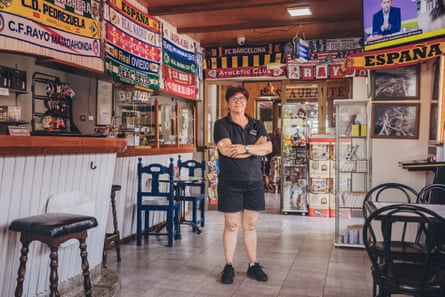
“We’ve had some big one-day events and parties, but we’ve never seen this kind of volume,” she said. “The eclipse is going to be a long day, but we have to make the most of it. We’re not going to see another day like it, are we? It’ll be unique.”
Cerezo, who also caters events, is hoping to get the necessary licences to set up a stall and a bar at the observation site. If she succeeds, she will need to hire another eight or nine people to supplement the restaurant’s regular workforce of nine people. Menu-wise, she’s thinking lamb stew, paella and an assortment of hot and cold sandwiches, all of which can be prepared in the hotel kitchen and driven up the mountain.
“If I do a massive paella and it runs out, I’ll ring down to my people in the kitchen here and they’ll prepare another one and bring it up,” she said. “We can’t leave people stuck halfway up a mountain with nothing to eat.”