Subaru's New 2026 WRX Base Trim Kicks A Lot Of Ass For $33,690 - Jalopnik
Subaru
I get to do a lot of really cool stuff in this job, but when I was asked if I'd like to travel to the UK with Subaru to drive the new base model 2026 WRX on a track, go to Jeremy Clarkson's pub, then attend the famed Goodwood Festival of Speed to watch Travis Pastrana huck the badass Brataroo up the hill, I squealed with delight. It's the same as asking your dog if they want to go for a walk — the answer is a hearty "hell yeah!"
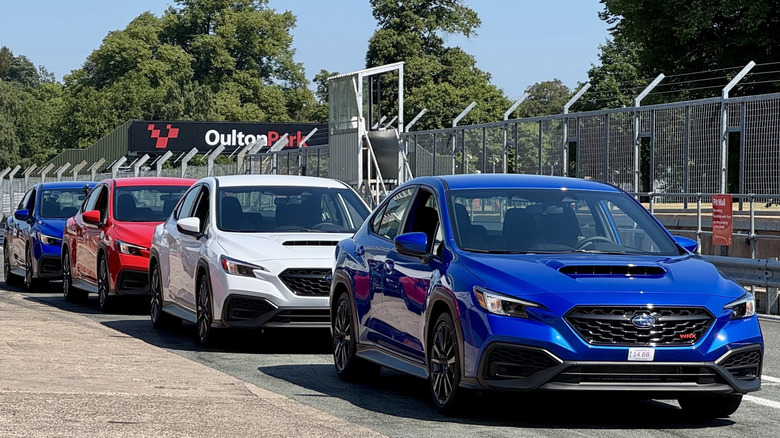
This was my first time in the United Kingdom, and the fun started as soon as I landed in Manchester. I stepped off the plane in a bit of a jet-lagged daze, was ushered into a strange van, and whisked off to Oulton Park racing circuit in Cheshire to see what $33,690 worth of base-model WRX could do on a race track. And so the adventure began!
 Logan K. Carter/ Jalopnik
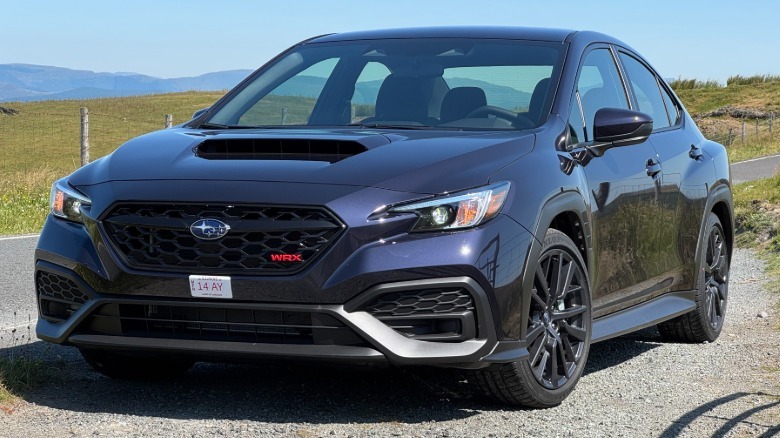
Full disclosure: The folks at Subaru invited me to join them on their annual pilgrimage to the Goodwood Festival of Speed in the UK, with the added privilege of testing out the new Base trim of the 2026 Subaru WRX. We drove left-hand-drive, U.S.-spec cars complete with Illinois plates and a big USA sticker on the back, so it was the same car that you'll see on your local Subaru dealer's lot. Subaru also put me up in lovely hotels and kept me fed during my trip.
My introduction to the car was on a track
Logan K. Carter/ Jalopnik
My first time behind the wheel of the 2026 Subaru WRX Base happened to be cruising out of pit lane onto the 2.7 miles of tasty tarmac at the Oulton Park International Circuit. I was hot off the heels of a BMW M Track Day at Willow Springs the week prior, where I had the pleasure of tracking some BMW M2s and M3 and M4 Competitions, so I was eager to see how a $33,690 car would feel after the Bimmers. I'm happy to report, the WRX Base does an admirable job of standing up against Bavaria's finest.
All Base trim WRXs come standard with the same drivetrain that this generation of WRX has had since launch, a tasty turbocharged 2.4-liter Boxer four-cylinder engine that sends 271 horsepower and 258 lb-ft of torque to all four wheels through an honest-to-god six-speed manual transmission. If you only have one leg or something, Subaru's so-called Performance Transmission, a CVT automatic, is also available as a $1,000 option on Limited-trim WRXs, and it's the only transmission offered on the WRX GT.
 Subaru
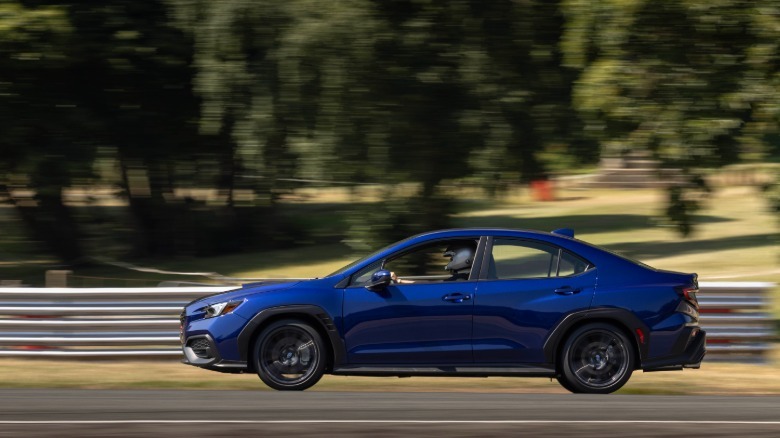
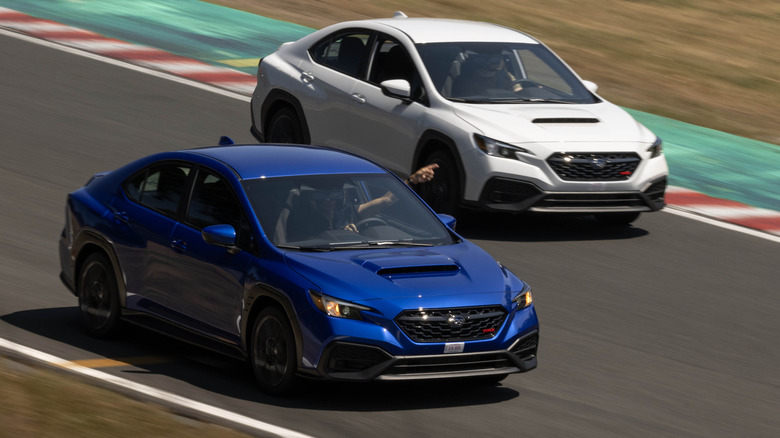
My row of three journalists eased our way onto the track following diligently behind our instructor for a few laps to learn the course before pushing things too hard. Oulton Park is a great track with lots of nicely banked corners, fun elevation changes, and a relatively easy-to-remember layout, plus I knew I could trust the WRX's signature symmetrical all-wheel-drive system to handle any little miscalculations on my part.
I thoroughly enjoyed tracking the WRX, and I think that was amplified by the manual transmission. All of the M Cars I drove the week before were automatic, and that's fine when you're working with as much power as those cars produce, but in something with fewer than 300 horsepower, the added challenge of navigating shift points and gear choices brought an added layer of mental complexity that was quite fun.
Not necessarily a track day hero, but still very capable
Subaru
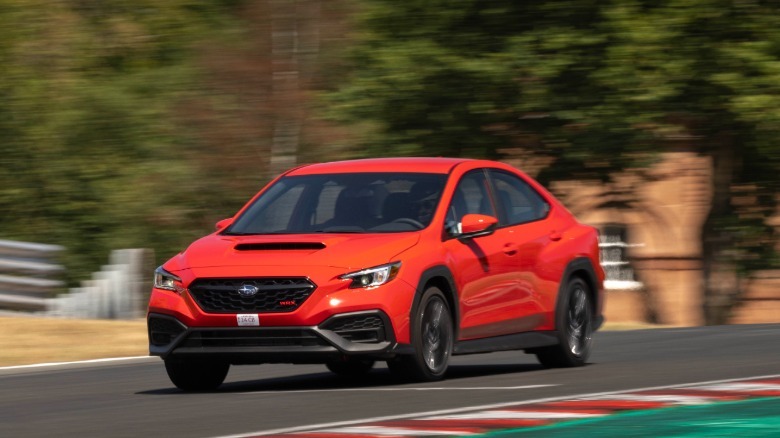
True to form, the WRX had great grip through slow and fast corners, doubtlessly helped by the standard 245/40 R18 Dunlop Sportmaxx GT performance summer tires. The steering wasn't overly communicative, but I could just about feel the nuances of the grip levels of the front tires, which required a bit of strategy to be their most obedient to steering inputs. It wasn't hard to find understeer when turning into corners, but things sorted themselves out nicely with a lift of the throttle or better turn-in speeds. Would other cars have been more fun around Oulton Park? Yes, but at $33,000, this tarted-up economy car held its own on a real race circuit, and absolutely delivered a fun driving experience. I bet some thicker anti-sway bars would make a noticeable improvement if track driving is important to you, which would be an easy and affordable aftermarket upgrade.
Despite a rather rowdy sound on startup and idle, the engine was still hard to hear through a helmet on the track, and since it makes most of its power at 5,600 rpm — just 400 shy of the low 6,000 rpm redline — I found myself eyeing the tach more than I'd like. But that's one of the fun parts of driving a manual car, and the Boxer produced a good amount of grunt so long as revs stayed above 3,000 rpm. More importantly, the engine felt plenty powerful and yes, fun, on the road, which is where WRXs will spend the vast majority of their real-world lives anyway.
 Subaru
The WRX Base's biggest shortcoming on the track were its brakes. Higher trim levels get Brembo six-piston calipers up front that clamp down on 13.4-inch cross-drilled rotors and two-piston calipers pinching 12.8-inch cross-drilled rotors in the rear, but the Base makes do with 12.4-inch discs and two-piston calipers in front and 11.4-inch discs and one-piston calipers in back. The standard brakes were fine in normal driving, but they began to fade on the track and felt worn-out by the time our track session ended and we took the WRXs on real roads. Brakes are also a relatively easy thing to upgrade, and for a $33,000 car, they're still plenty capable.
Hitting the road
Logan K. Carter/ Jalopnik
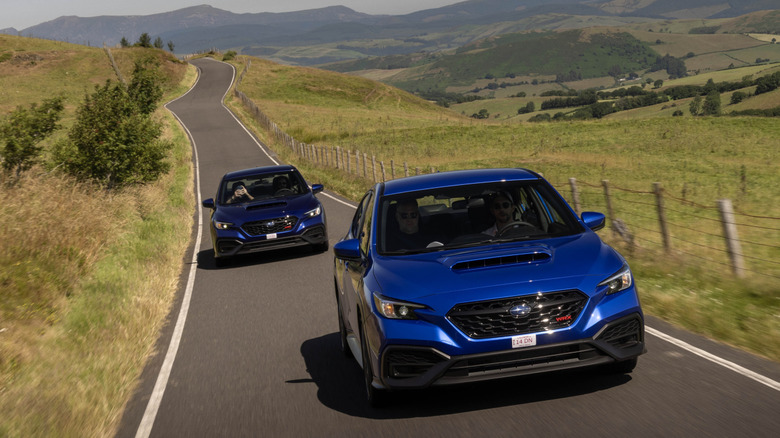
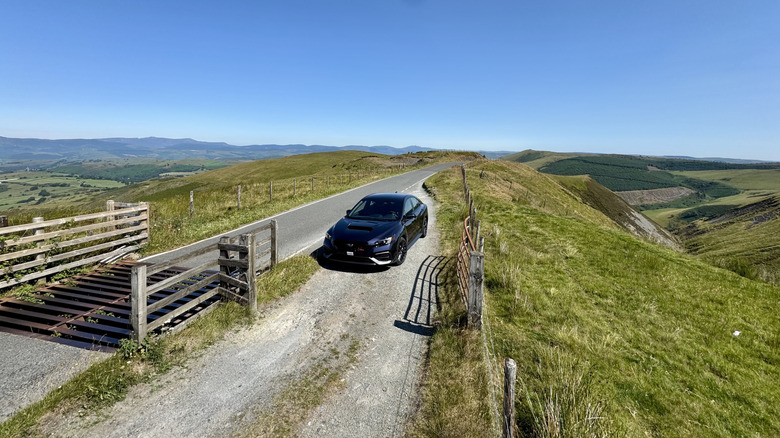
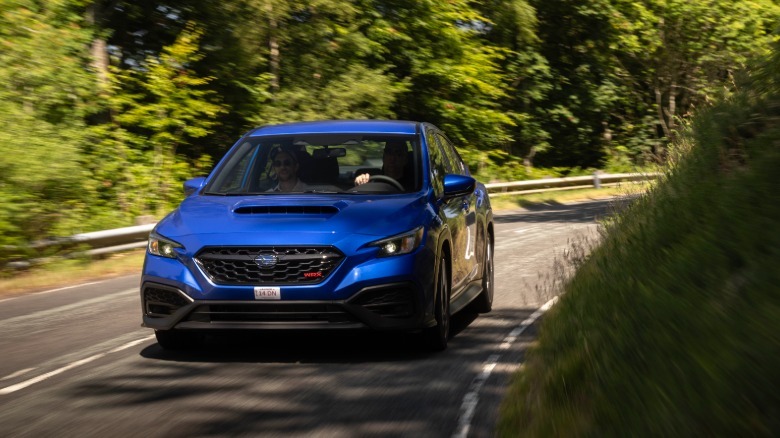
After our track day, we drove to our first hotel that happened to be at the end of a beautiful array of winding country roads. Unfortunately, most of those roads were about six inches wider than the WRX's wing mirrors, and for some reason they were two-way roads. Driving a left-hand-drive car on the wrong side of hedge-lined roads with blind corners made for a tense time, but when the roads widened a bit, the WRX was a delight to wring out. The understeer I noticed on the racetrack is hard to access at reasonable speeds on public roads, and I could take tight turns with tenacity. It was a hoot to drive.
The narrow roads meant pothole dodging was out of the question, so I encountered some pretty harsh, crashy impacts. Over less cratered roads, the WRX's suspension felt busy and firm, but that shouldn't deter most prospective performance car buyers.
 Subaru
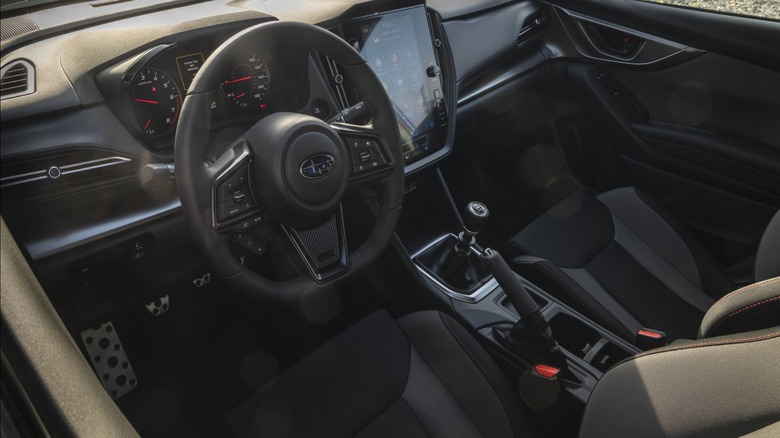
Anyone who's intimidated by the thought of owning a car with a manual transmission should take a spin in the WRX Base. Its standard hill-hold assist made starting on an incline a stress-free experience, and the nicely weighted clutch was kind to my left leg, even in stop-and-go traffic. As a whole, the WRX Base was an excellent daily driver that offered an easy going demeanor in mundane scenarios and a playful one when the mood struck. Over the course of my three rather warm, muggy days piloting one around the U.K., my co-driver and I also came to appreciate its exceedingly chilly air conditioning. The biggest demerit against the WRX as a daily driver is its poor fuel economy, rated for just 19 mpg in the city, 26 mpg on the highway, and 22 mpg combined when fitted with the manual transmission. Opting for the Subaru Performance Transmission drops each rating by one, making it a rather thirsty little thing, but did I mention that it's only $33,000?
Aside from the driving experience, WRX Base models get a lot of standard features like dual-zone automatic climate control, Subaru's (admittedly bad) 11.6-inch infotainment system with wireless phone mirroring, LED headlights, and Subaru's EyeSight suite of active driver assistance features like adaptive cruise control with lane centering, lane departure warning, and automated emergency braking. During my three days with the car I didn't find myself wanting for any features, and I even thought the standard stereo system was pretty good, which was a pleasant surprise.
Other trims bring more features, but the WRX Base represents the best value
Subaru
Subaru did the unthinkable for 2026: it lowered prices for every WRX trim level, though I feel the WRX Base still represents the best value at $33,690, including destination. The WRX Premium is now nearly $4,000 cheaper than last year at $35,190; it adds front fog lights, heated front seats and exterior mirrors, rear USB ports, and a body-color rear spoiler. Stepping up to $40,190 Limited trim gets you an 11-speaker Harman Kardon stereo, a 10-way power-adjustable driver's seat, blind-spot monitoring, a power moonroof, Ultrasuede seats, and steering-responsive headlights.
WRX GTs cost $46,190 and gain red-and-black Ultrasuede Recaro front seats, a digital gauge cluster, and an adjustable sport-tuned suspension. The WRX tS is the most driver-focused trim, with 19-inch wheels, Brembo brakes, STI-tuned adjustable drive modes, a moonroof delete, and a sport-design digital gauge cluster for the same $46,190 as the GT. Finally, there's a special limited-edition WRX Series.Yellow that's based on the tS, with unique Sunrise Yellow paint and yellow interior accents for $47,190. It's limited to just 350 units.
Though it may not be quite as titillating as its trailblazing predecessors, and we're still desperately clinging to the hope that Subaru will one day STI-ify the WRX again, this is the WRX we have now, and it's still a great choice for enthusiasts on a budget. As a whole, the Subaru WRX Base is an easy-to-love all-wheel-drive performance car that's affordable, practical, easily modifiable, and fun. For only $33,000!