Swedish MEP files police complaint accusing Danish colleague of racist hate speech
A Swedish MEP has filed a police complaint accusing a fellow MEP of racist hate speech after she was targeted on social media over her condemnation of far-right, anti-immigration chants in the European parliament.
The complaint, which was filed last week with police in Sweden, relates to the aftermath last month of the decision by some rightwing MEPs to erupt in chants of “send them back” following a vote aimed at increasing deportations across the EU.
Soon afterwards, Abir Al-Sahlani, an Iraqi-born Swedish MEP with the Centre party, addressed the hemicycle, accusing the “fascists of the far right” of sinking to a “new low” with their chants.
“I have never felt as unsafe in this parliament,” she told the chamber. “The shouting of the far right was not against a political opponent, it was ‘send them back’. It was about ordinary people who did no other ‘crime’ than looking for a better life in Europe.”
As her comments made the rounds on social media, two MEPs from rightwing populist parties shot back at her online. “Cry more,” wrote the Finnish MEP Sebastian Tynkkynen, of the Finns party, in response to a clip of Al-Sahlani addressing parliament, while the Danish MP Kristoffer Storm, of the Denmark Democrats, said she “should go home”.
On Wednesday, Al-Sahlani said she had filed a police complaint against Storm, accusing him of using racist speech as well as hate speech against her. Her complaint had only focused on the Danish MEP, she said, as Swedish police were unsure of how to handle Tynkkynen’s social media post.
Both men have denied the accusations against them.
The confrontation hints at the deep divisions that course through the European parliament, where far-right and rightwing populist MEPs now make up about a quarter of lawmakers – a record for the chamber – while people from minority ethnic backgrounds remain drastically underrepresented.
Speaking to the Guardian days after she was targeted online, Al-Sahlani said she still was not quite sure what to make of it all. “I don’t know if I am disappointed or sad,” she said. “I feel sadness for European democracy, like, really, this is the level of our politicians? But also disappointed because, really, c’mon guys. I’m your colleague.”
The comments by the rightwing lawmakers prompted a wellspring of support for Al-Sahlani online, punctuated with a smattering of rape and death threats. Her group in parliament, Renew Europe, lined up behind her.
“Racism has no place in our institutions, and those who spread it must face the consequences of their actions,” Valérie Hayer, who heads the group, said on social media in response to Storm’s “go home” comment.
In a letter sent soon after, Hayer called on the president of the European parliament, Roberta Metsola, to take disciplinary action against Storm and Tynkkynen.
“I am particularly concerned that a member of my group, MEP Al-Sahlani, is being targeted and threatened on social media by fellow members,” Hayer wrote. “A clear and consistent response would send an important message that intimidation, harassment and behaviour that demeans our institution have no place in the European parliament.”
In a statement, Metsola’s office described the incidents as “regrettable”, adding that there was zero tolerance for actions that undermined the respect of MEPs or the dignity of the institution. The parliament’s services were currently looking into what had happened, it added.
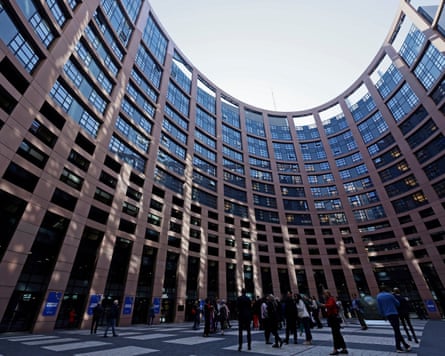
On Monday, Metsola addressed parliament, telling lawmakers the “aggressive chanting, jeering, finger-pointing and filming of members that took place” was not acceptable. “There is a line, and that was crossed last plenary,” she said, adding that her office would “take appropriate action to ensure that the scenes we witnessed last month” would never happen again.
Al-Sahlani said she had initially wavered on whether to speak up after the chants. “People with my colour skin – there are not so many of us in that room,” she said. “I hesitated for a very long time. Should I take the fall? What will they then scream at me?”
She pushed aside her concerns as she considered the broader context. “They attacked people who have no power. And that should scare anyone in Europe, because if you start to attack the weakest people, then it’s a slippery slope towards something much, much worse,” Al-Sahlani said.
The situation was being aggravated by those on the centre right who were “enabling the fascists”, she added, citing as an example the deportations legislation that had set off the chants.
The legislation, which Amnesty International has described as “absurd, cruel and discriminatory” and has been criticised by more than a dozen UN experts, was passed after much of the centre right opted to join forces with the far right rather than work with pro-European, pro-democratic parties in the parliament.
“We could have had better legislation,” Al-Sahlani said. “But they chose the most inhumane, undignified content for that kind of legislation and went with it.”
Tynkkynen pushed back in an email at Hayer’s allegations that he had threatened or made comments of a racist nature towards Al-Sahlani, describing them as “false accusations”.
He said he planned to file a complaint regarding these accusations, but did not provide more details, saying only that the “form of the complaint is still under consideration”.
Storm said in an email that his remarks “were neither intended to be racist nor can they be reasonably characterised as racist”.
Soon after the incident, he explained his view to Politico: “The phrase ‘go home’ was intended to mean that if she found the democratic decision and the reactions to it so distressing, she would have been better off leaving the chamber and taking time to reflect rather than accusing a big majority of political opponents of making her feel unsafe.”
Al-Sahlani brushed off the explanation. “People are smarter than this,” she said.