The Move Over Rule Exists In All 50 States And 1/3 Of Drivers Still Ignore It - Jalopnik
Charles-McClintock Wilson/Shutterstock
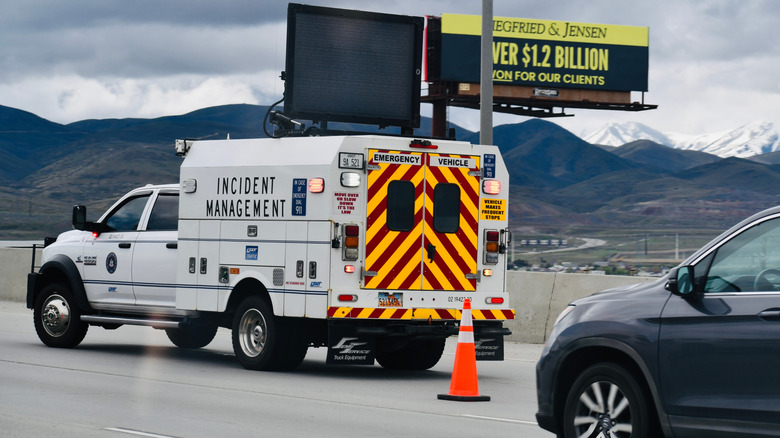
In 2022, the AAA studied footage from traffic cameras across the country. Study authors were looking at the scenes of accidents as well as road construction, cops pulling over drivers, and where tow trucks were extracting disabled cars. But they weren't idly observing service personnel — they were trying to discern compliance with so-called move-over laws that legislators have put on the books across all 50 states. These statutes, at a minimum, require drivers to move out of the adjacent lane when passing emergency vehicles with flashing lights. What the AAA study authors found after looking at footage of over 12,000 cars passing emergency and other vehicles was pretty pitiful compliance: One-third of drivers simply ignored these laws.
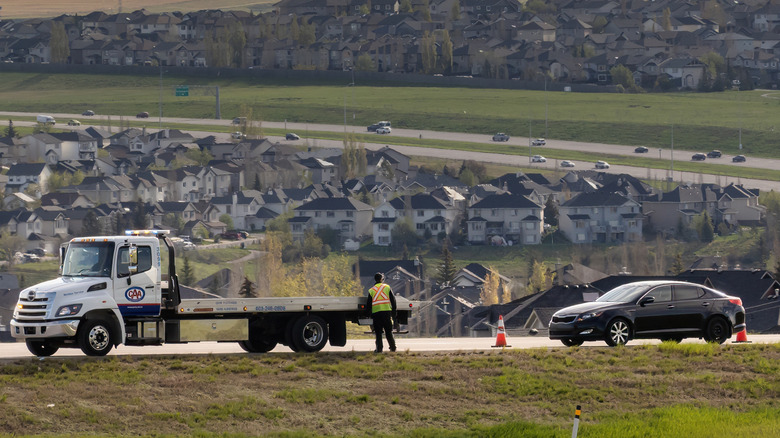
The most glaring instance of non-compliance was in moving over for tow trucks. All 50 states require either moving over or significantly slowing down to avoid driving directly by stationary tow trucks, but only 58% of drivers actually complied with these rules. That unfortunately directly translates to putting anyone in the towing profession at tremendous risk. According to the CDC, from 2011 through 2016, there were 191 deaths among people who worked towing cars in America.
This number translates to an annual fatality rate that's more than 15 times the average rate for all private industries combined. Put another way, that's a one in 2,326 chance per year of getting killed -– often by vehicle collisions, such as by a car slamming into you while you're on the roadside working. Sadly, what that means is that you are 430 times more likely to be killed as a tow truck driver than to be struck by lightning –- which, according to the CDC, has roughly one-in-a-million odds. (Also, most lightning strike victims survive.) As for improving tow-truck drivers' odds — and those of EMS workers and of cops — AAA has a few ideas.
Pull over or pay up
Habanero Pixel/Shutterstock
Among AAA's suggestions, the agency wants to see clearer, more consistent laws nationally. Plus, stiffer fines that drivers know about. Illinois is a good example of a state with stout laws and fines. Scott's law requires drivers to move over for EMS displaying flashing lights, which includes pulling onto the shoulder to let them pass or slowing down or moving over a lane when these vehicles are already at an accident scene. Drivers also have to yield to EMS and pedestrians involved in emergencies. Illinois imposes a minimum fine of $250 and up to $10,000 for a first violation of its move-over law. Do more damage, like hitting a car while not moving out of the way, and you'll lose your license and possibly go to prison. Illinois isn't messing around –- probably in no small measure because Scott's Law is named for Chicago Fire Department Lieutenant Scott Gillen, who was killed by a drunk driver while responding to an accident.
But not all states protect you when you're stuck on the side of the road. In fact, only half of all states include statutory penalties for not steering around disabled, pulled-over cars, and in 2024 alone, there were 578 deadly crashes involving cars on the shoulder of the road. Some states, however, have started issuing harsher penalties for failing to slow down or give a wide berth to disabled vehicles and emergency workers. Among those, you'd better comply in Pennsylvania or Colorado.
You'd better move over in Colorado and Pennsylvania
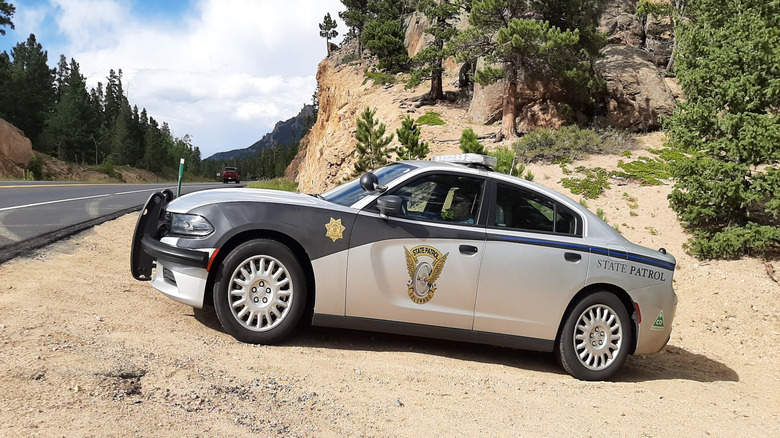
photo-denver/Shutterstock
The number of states that require you to move over when you're passing a car with its flashers on has risen from just nine when AAA made its survey in 2022 to at least half in 2025, and Colorado law is one of the most restrictive. You have to slow down by at least 20 mph below the maximum speed limit, and if you get nabbed for failing to do that, you'll get a $150 ticket and a gnarly three points on your license. You can also go to prison for causing an injury or death, plus face fines of up to $100,000.
In Pennsylvania, the first fine is stiffer. It's $500 for the first violation and $1,000 the second time around. This is ten times the maximum 50 bucks that California imposes, and unlike in Pennsylvania and Colorado, which require you to cut your speed by 20 mph below the speed limit, California law says that if you can't move over easily, you just have to "slow to a reasonable and prudent speed." In a state that allows motorcycles to lane split –- always controversial, mind you –- "reasonable and prudent" to us sounds a lot like the fact that the Golden State says weed spilled in your car doesn't violate California's open container laws.
If you're AAA, and really if you've ever been stuck on the side of the Interstate with cars whizzing past, some sanity here would include drivers knowing the law and obeying it. And while we're at it, maybe drivers could also learn that it's illegal to camp in the left lane, and you'd better be passing slower traffic if you use that lane.