Trump claims agreement for ‘complete disarmament’ of Hamas in Gaza but support uncertain
Donald Trump has said a deal has been reached for Hamas to disarm and for Israel to withdraw its forces from Gaza, however briefings from both sides exposed disputes over its implementation that could prove difficult to overcome.
“This agreement is a critical step towards Gaza finally being governed by a new Palestinian government that will work closely with the Board of Peace to help the Palestinian people,” Trump said in a social media post.
“At the same time, Israel will have the security it deserves, with Gaza no longer used as a base for terror attacks.”
A US-brokered ceasefire was signed between both sides last year, but negotiations between Israel and Hamas had remained largely deadlocked over the implementation of its second phase, including the disarmament of Hamas and the reconstruction of Gaza.
Trump’s 20-point ceasefire plan announced last year calls on the Iran-backed militant group to surrender its weapons and destroy its vast network of tunnels. It also envisions Israeli forces withdrawing from Gaza, the arrival of a new technocratic Palestinian government, deployment of an international security force and the rebuilding of the battered Palestinian territory after more than two years of war.
Senior Hamas officials have reportedly agreed to the plan, but the question of whether the group disarms before or after Israel’s withdrawal from Gaza has already emerged as a point of contention.
“We will not take any action regarding disarmament prior to Israel’s withdrawal from the Strip,” Ghazi Hamad, a member of the Hamas negotiating team, told Al Jazeera.
Hamad told Agence France-Presse in a separate interview: “The agreement contains a clear provision stating that Israel must commit to and implement its obligations. If Israel does not implement the agreement, neither will we.”
Earlier an Israeli official told the Reuters news agency that the proposed terms were not satisfactory.
“Israel demands the complete disarmament of Hamas, including the removal of weapons from Gaza and the complete demilitarisation of the Strip as a precondition for any process,” the official said, adding that the plan under discussion did not “provide a satisfactory response to these demands and Israel conveyed its objections”.
In a briefing to reporters late on Thursday, a US official appeared to acknowledge that differences between the two sides remained, saying Israel was “very sceptical that Hamas will disarm”.
The official added that Trump would be “very, very disappointed” if Israel didn’t adhere to the agreement.
Hamas’ founding charter calls for armed resistance against Israel, and it has been reluctant to give up an arsenal, including rockets, anti-tank missiles and explosives, that lies at the heart of its identity.
The group announced earlier this month that it had dissolved its government in Gaza and was preparing to transfer power to a technical committee backed by the United Nations as part of the ceasefire deal.
Speaking on Thursday, US and Board of Peace officials were unable to offer specific timelines for the disarmament of Hamas or other groups that operate in Gaza such as Palestinian Islamic Jihad, but suggested it could take between 200 and 350 days.
Hamas wants Israel to commit to ending attacks on Gaza and withdrawing its forces, and its leaders will reportedly hold talks with mediators from Egypt, Qatar and Turkey on the second phase of Trump’s Gaza plan in the coming days.
Hamad told AFP: “This process will take about 14 days, or perhaps longer. We must agree on every detail: how the agreement will be implemented, when it will be implemented and the mechanisms for carrying it out.”
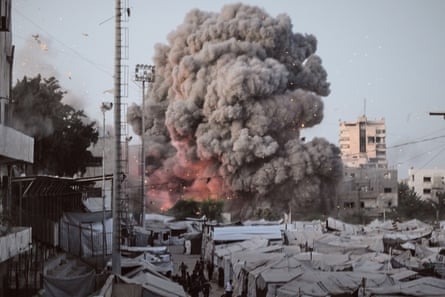
So far, the reality on the ground in Gaza remains far from this roadmap.
Israeli strikes killed at least six Palestinians in Gaza on Thursday, including two children, local medics said.
The Israeli military has continued to expand its military occupation of Gaza, with the prime minister, Benjamin Netanyahu, saying that Israel intends to expand the area under its control to 70% of the territory.
It remains unclear how many forces would be available to deploy with the planned International Stabilisation Force, and whether Israeli troops would withdraw from the territory.
With Reuters, Associated Press and Agence France-Presse