We are living fewer years in good health: Is the NHS part of the problem?

ByEleanor Lawrie
Social affairs reporter
Angie currently lives in the English Midlands but is preparing to move to Bulgaria. She has suffered for years from multiple chronic health issues including ME and an autoimmune thyroid condition. She says holidaying in Bulgaria has been transformative - enough that she has decided to leave the UK.
A strong sense of community and the fresh air of the Bulgarian mountains are part of the pull.
But she also feels the Bulgarian healthcare system is more responsive than the one she is leaving behind in the UK.
"You have to pay a small fee to see a doctor, but then you see one quickly," Angie says, describing her experience in Bulgaria.
While she is "very glad" the free at the point of use NHS exists, she believes it is failing to deliver. "People aren't getting a service - particularly with chronic health issues - that actually makes a difference to their health outcomes or quality of life," she says.
"Once you're diagnosed, that's it, you're left to your own devices. I've had to spend a fortune on private healthcare because I couldn't get any improvements [with]in the NHS."
A 2025 study from National Voices charity found 37% of people with a long-term health condition did not feel supported by the NHS to manage their physical health, compared with 16% of those with no long-term conditions.
 Image source, NurPhoto via Getty Images
Angie is preparing to move to Bulgaria - partially because of her health
Unlike the UK, Bulgaria's healthcare system is a mix between public and private. Employees, including foreign nationals, pay a compulsory 3.2% of their pre-tax salary into a healthcare insurance fund topped up by their employer. However, there are many extra costs for non-emergency medical treatment, such as doctor's appointments. Despite progress, Bulgaria's health outcomes are ranked relatively poorly by the OECD. But other countries without tax-funded systems do perform strongly.
Angie has become one of a growing number of Britons living with ongoing poor health. More working‑age adults are reporting long‑term health conditions, with 36% saying they had at least one in early 2023, up from 31% in the same period of 2019.
Healthy life expectancy - the years in which a person can expect to live in good health – has fallen in the UK in recent years, while it has increased in most other wealthy countries. While life expectancy has stagnated, in more than 90% of areas, healthy life expectancy has dropped below the state pension age, with Britons now living about a quarter of their lives in poor health.
While life expectancy in the UK has recovered after the Covid-19 pandemic, healthy life expectancy has worsened, particularly in the most deprived areas.
Across the country, healthy life expectancy in 2022-2024 was 60.7 years for men and 60.9 years for women, according to the Office for National Statistics (ONS). This was a drop of 1.8 and 2.5 years respectively compared with 2019 to 2021, and the lowest level since the analysis began in 2011. The UK was one of only five of the world's richest 21 countries to see healthy life expectancy decline.
Meanwhile, many countries without tax-funded healthcare systems record more years lived in good health than the UK, according to the World Health Organization.
Healthy life expectancy is not a perfect metric; it is self-reported and so relies on how people feel about their own health. However, the Health Foundation describes it as a "key measure" of the population's health, because it can provide a more comprehensive picture of what's happening under the surface than life expectancy alone.
A Department of Health and Social Care spokesperson told the BBC it is shifting the focus of healthcare from sickness to prevention. "We are committed to reducing health inequalities, GP patient satisfaction is up, and waiting lists are down by 340,000 compared to July 2024," they said.
So what is driving the UK's fall in healthy life expectancy? And why is a nation with a system specifically designed to give everyone equally good care lagging behind others?
What's the alternative?
The UK is facing similar issues to many of its peers; an ageing population, cost of living pressures and a growing burden of mental health problems.
But while citizens of many other countries report improvements to their health, those in the UK say it is getting worse. Health Foundation analysis of ONS figures shows the share of adults rating their health as "good" or "very good" dropped from 76% in late 2020 to around 71% in late 2025, a decline of 5%. Meanwhile in countries such as Bulgaria and the Netherlands the proportion of people reporting good health has risen.
Gareth Lyon, head of health and social care at right-leaning think tank Policy Exchange, argues the UK's decline can partly be laid at the door of its "creaking" National Health Service. "The UK is becoming an outlier… we're not prepared to look at how we make our system sustainable for patients in the long run," he says.
He points to Health Foundation figures suggesting access to GP appointments and early medical intervention lag behind the Netherlands, with half of Britons reporting they "always or often" receive a same-day response from their GP, compared to eight out of 10 Dutch people.
Meanwhile, one in five British patients wait over a year for non-urgent surgery; in the Netherlands the figure is zero.
Lyon blames this on the UK healthcare model in which the state both funds and provides treatment; this lack of competition means there is little motivation for contract holders to become more efficient, save costs or respond quickly to patient concerns, he says. Although patients in the UK can opt to go private if they can afford it.
Instead, he argues the UK should largely replicate the Dutch healthcare system, in which adults pay for compulsory health insurance, with subsidies offered to those on low incomes, which he says has created a highly competitive environment among insurers and healthcare providers, incentivising the best treatment for patients.
Since this model was adopted 20 years ago, Lyon says the Dutch have seen a "massive expansion of primary care, early diagnosis and treatment" while still offering universal healthcare.
 Image source, AFP via Getty Images
Life expectancy in the UK has recovered after the Covid-19 pandemic, but healthy life expectancy has worsened
But Sebastian Rees, head of health at the left-leaning think tank Institute for Public Policy Research (IPPR), rejects the idea that competition between providers or insurers improves healthcare or boosts healthy life expectancy.
He points to IPPR's recent analysis of 22 high-income countries which found no evidence insurance-based systems like the Netherlands' outperform tax-funded models on measures such as access or quality.
Instead, the report suggests performance varies far more within funding models than between them, and claims the NHS's poor performance against other countries is partly driven by chronic underinvestment.
'A sense of hopelessness'
Rees also points out that the UK and the Netherlands have markedly different population profiles, which he argues is a far more powerful driver of healthy life expectancy. For example, the Netherlands' obesity rate is almost half that of the UK. It also has lower child and family poverty, lower unemployment and higher disposable incomes.
"All of that is likely doing far more for population health in the Netherlands than competition between providers," he says.
For Rees, this is the heart of the UK's problem, and helps explain why countries can offer universal, free health services and still fall behind. Different parts of the UK show a stark disparity for health life expectancy: a woman in Richmond‑upon‑Thames can expect to enjoy a healthy life two decades longer than one in Hartlepool.
Prof Martin McKee from the London School of Hygiene and Tropical Medicine has spent his career comparing different countries' healthcare systems.
He argues the NHS has suffered from years of underinvestment since austerity policies were introduced. "The UK has constantly been scrimping and saving… we are low on scanners, low on everything, way behind everybody else," he says.
Like Rees, he suggests the roots of the UK's healthy life expectancy lies in poverty and lack of opportunity.
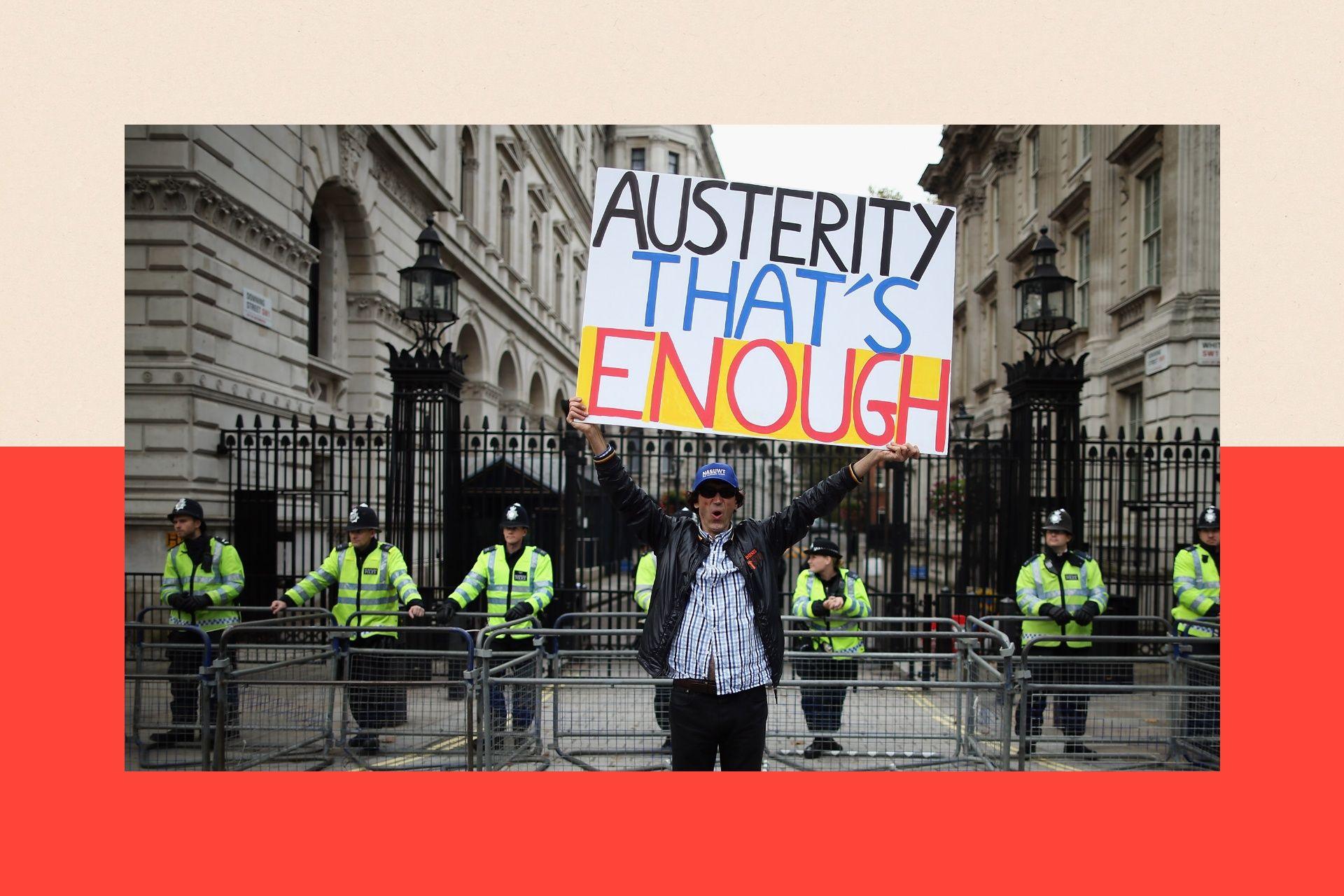 Image source, Getty Images
Some suggest the roots of the UK's healthy life expectancy lie in poverty
Austerity worsened the problems of regional inequality, he says, and that has been further exacerbated by a growing burden of mental health problems since the noughties.
"There's a lot of young people, particularly young men, who are in poor mental health and to some extent poor physical health too. Basically, groups who are marginalised, left out, left behind… A lot of it is to do with a sense of hopelessness," he says.
Around one in four adults aged 16 to 29 years were experiencing moderate to severe depressive symptoms in April last year, the ONS says, while across the UK, those in the poorest fifth of the population are twice as likely to be at risk of developing mental health problems as those on an average income.
Much of the UK's decline in healthy life expectancy is concentrated among marginalised groups, who are more likely to live in Scotland and the North of England, McKee points out.
It is no coincidence that these areas also contain the hotspots for "deaths of despair" – deaths resulting from drugs, alcohol and suicide. Many of the factors behind these deaths of despair, including addiction, poor diet and stress, also contribute to people spending more of their lives in ill health.
The 15-minute GP appointment
Some doctors are testing new approaches, seeing if tweaking the way NHS works can deliver better health. Dr David Blane is a GP in Glasgow's Possilpark, and academic lead for GPs at the Deep End, an organisation led by doctors in Scotland's most deprived communities.
He says patients in these neighbourhoods typically develop multiple long‑term conditions 10 to 15 years earlier than those in wealthier areas.
"Not only is there a good chance that you've got more long‑term health problems, but there's also other things going on in your life impacting on your mental health - lots of low mood, depression, chronic pain… These things have a big impact on your quality of life, your sense of self, your sense of purpose."
Part of GPs at the Deep End's role is to pilot new strategies to try to reduce healthcare inequalities.
One strategy has been to extend all appointments to 15 minutes. "That certainly helps with empathy. It helps with managing potentially more than one problem in a consultation and GP stress as well," Blane says.
But the most important factor, he argues, is continuity of care - seeing the same clinician each time. "Continuity of care saves lives, and it can also help to facilitate better access, better follow ups, and just better health outcomes," he says. "Over the last 10-15 years, the political emphasis has been much more on rapid access [to treatment], which is important for some things, but not for everything".
Blane is also helping evaluate new family wellbeing support workers in Glasgow. These staff link patients to money advice, housing help, trauma counselling, language support and physical activity programmes. The model, he says, creates "sticky" engagement with those who might otherwise drop out of the system and could, he adds, be replicated with families across the country.
Looking to the future
The issue, of course, is how these services should be funded in the long term.
Dr Kristian Niemietz, head of political economy at the Institute of Economic Affairs (IEA), a right-leaning free-market think tank, says no health system is insulated from the wider economy, but his view is that in an insurance‑based model, funding tends to be more stable. He says it avoids the "feast and famine" cycles that have characterised NHS budgets.
He argues that a more competitive market is best placed to deliver improvements. "So if it turns out that, say, continuity of care, greater integration, that improves outcomes - then a competitive market would lead to that, like it does in other sectors.
Others say the NHS should be retained because tax‑funded systems are best placed to deal with the challenge of aging populations.
McKee argues this is the "by far the best way of doing it" as the costs are borne by more of the population. He argues that with fewer people in paid work supporting a growing number of older citizens, who typically need more healthcare, systems that rely on insurance premiums or employer‑based coverage come under strain.
In Rees' view, there's no such thing as a "best" system for health outcomes. He argues that high performers exist across every system type, and their success owes far more to factors outside healthcare than within it: tax-funded systems like Norway, Iceland, Sweden and Spain do well, but so do social insurance systems in Japan, South Korea, Switzerland and Israel.
For patients, those debates surface in more immediate ways. Although Angie is preparing to move to Bulgaria, she hasn't given up on the NHS. She describes it as under incredible pressure, but still believes "we're incredibly lucky to have an NHS". Her frustration, she says, is with how hard it has become to access care.
Top picture credit: EPA-EFE/REX/Shutterstock / PA

BBC InDepth is the home on the website and app for the best analysis, with fresh perspectives that challenge assumptions and deep reporting on the biggest issues of the day. Emma Barnett and John Simpson bring their pick of the most thought-provoking deep reads and analysis, every Saturday. Sign up for the newsletter here
Get in touch
Are you personally affected by the issues raised in this story?
- Life expectancy
- Health
- NHS
- Healthcare